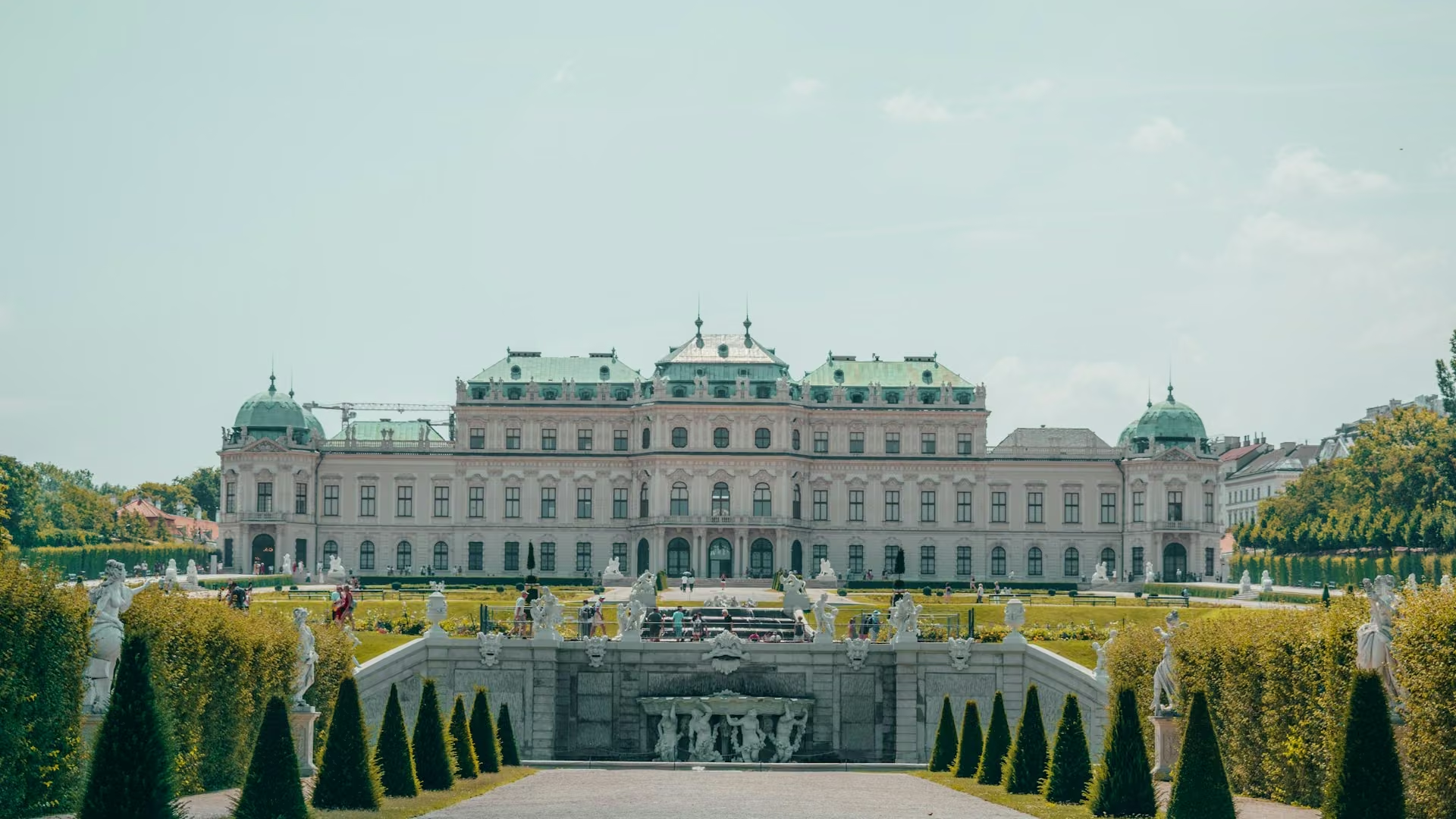
This is the long way down the Danube, and it is all the better for it. Starting among Vienna's palaces and coffee houses, you follow the river through seven countries and finish in Bucharest, with time along the way for Croatian wine, Serbian fortresses and Bulgaria's role in the making of modern Europe.
The route
Vienna · Bratislava · Danube Bend · Budapest · Mohács · Vukovar · Ilok · Novi Sad · Belgrade · Donji Milanovac · The Iron Gate · Vidin · Pleven · Constanța · Bucharest
About the Capitals of Eastern Europe cruise
Capitals of Eastern Europe is Viking's 17-day Danube cruise from Vienna to Bucharest, crossing Austria, Slovakia, Hungary, Croatia, Serbia, Bulgaria and Romania. It begins with three days in Vienna, then sails to Bratislava and on through the Danube Bend to Budapest. From there you head south into the Balkans, stopping at Mohács, Vukovar and Ilok, Novi Sad and Belgrade, before the Iron Gate gorges lead you down into Bulgaria and Romania. The final days take you to Constanța on the Black Sea coast and Bucharest.
The appeal of this route is the way the Danube links worlds that feel very different. Vienna and Budapest show the polish of the Habsburg empire. Further south, Ottoman history comes to the fore at Mohács, Belgrade and Vidin, and the Russo-Turkish War of 1877 is remembered at Pleven. You also pass through regions that have changed hugely since the 1990s, such as eastern Croatia and Serbia. Along the way there is plenty of good food and wine, from Viennese pastry to Ilok's white wines.
You sail on a Viking Longship, where every stateroom faces the river. The fare includes return flights from London and selected regional airports, a shore excursion in every port of call, all meals on board, beer, wine and soft drinks with lunch and dinner, specialty coffee, tea and bottled water at any time, free Wi-Fi, port taxes and fees, enrichment talks and onboard gratuities. With seventeen days, the ship becomes a comfortable home base rather than just a way of getting from one city to the next.
Prices start from £4,795 per person. We checked this in October 2026, and fares vary with the departure date and the stateroom you choose. This itinerary suits travellers who have time for a longer holiday and want to understand the whole sweep of the Danube rather than one stretch of it. Viking also offers pre-cruise extensions to Venice and Zagreb or Prague, and post-cruise options to Transylvania or Istanbul. If you would like help deciding whether to add one, or which stateroom to pick for a cruise of this length, email us and we will happily talk it through.
For more on the river itself, see our The Danube river cruise guide.
Cruise highlights
Three days in Vienna
Time to enjoy the city of Mozart, Beethoven and Strauss properly, with imperial palaces, museums and the famous coffee houses.
Bratislava and the Danube Bend
Slovakia's compact capital with its hilltop castle, then a scenic sailing through the Danube Bend on the way to Budapest.
Croatia's easternmost corner
The prehistoric Vučedol culture and recent history in Vukovar, followed by wine and local food in hilltop Ilok.
Serbian fortresses
Petrovaradin above Novi Sad, Kalemegdan in Belgrade and the gorges of the Iron Gate, with prehistoric history at Donji Milanovac.
Bulgaria's story
Vidin's medieval Baba Vida castle and Pleven, scene of the great siege of 1877 that helped Bulgaria win its freedom.
Black Sea and Bucharest
Constanța's waterfront and art nouveau casino, then two days in Romania's capital to finish.
Day by day itinerary
Welcome to Vienna
Your cruise begins in Austria's capital, a city that has shaped European music more than almost any other. Haydn, Mozart, Beethoven, Schubert and the Strauss family all lived and worked here, and Johann Strauss II's Blue Danube waltz, first performed in 1867, has become the unofficial anthem of the river. Today you see some of the city's grand architecture and learn about its musical heritage. The Ringstrasse, the great boulevard created on the line of the old city walls from 1857 onwards, is lined with landmark buildings including the State Opera, the Parliament and the City Hall. It is a wonderful introduction to the city.
Museums and pastry
A second day in Vienna gives you the freedom to follow your own interests. The Kunsthistorisches Museum has one of the world's great collections of Old Master paintings, including a superb room of works by Pieter Bruegel the Elder. The Belvedere holds Gustav Klimt's The Kiss, and the MuseumsQuartier brings modern art into the old imperial stables. When your feet need a rest, Vienna's coffee houses are made for lingering. The Sachertorte, a rich chocolate cake first created by Franz Sacher in 1832, is the classic choice, though apple strudel and the many cream cakes have plenty of fans too.
Imperial Vienna
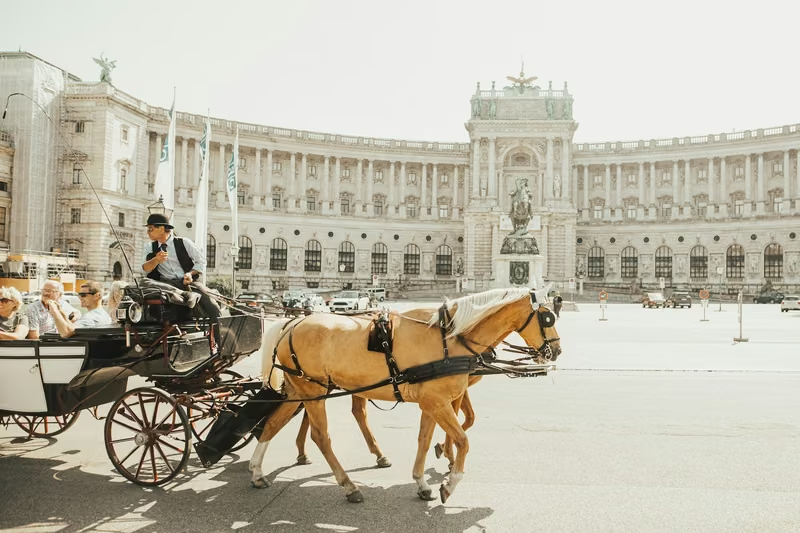
Today focuses on the Habsburgs, who ruled from Vienna for more than six centuries. The Hofburg was their winter residence and now houses the Sisi Museum, the imperial apartments and the Spanish Riding School, where the famous Lipizzaner horses perform. Out of the centre, Schönbrunn Palace was the summer residence, a vast baroque palace with formal gardens and the Gloriette on the hill behind. St Stephen's Cathedral, with its tall Gothic spire and patterned tiled roof, is the spiritual centre of the city. In the evening, a concert of Mozart or Strauss is a lovely way to round off three days here.
Slovakia's capital and the Danube Bend
Bratislava lies only about 60 kilometres downstream from Vienna, and for centuries it had close ties to the Habsburgs. Known then as Pressburg, it was where the kings and queens of Hungary were crowned between 1563 and 1830, Maria Theresa among them, in St Martin's Cathedral. You see Habsburg-era palaces in the old town and the square, white Bratislava Castle with its four corner towers on the hill above the river. Later the ship sails through the Danube Bend, where the river turns sharply south between wooded hills. Look out for the great domed basilica at Esztergom and the castle ruins high above Visegrád.
Castle District and Pest
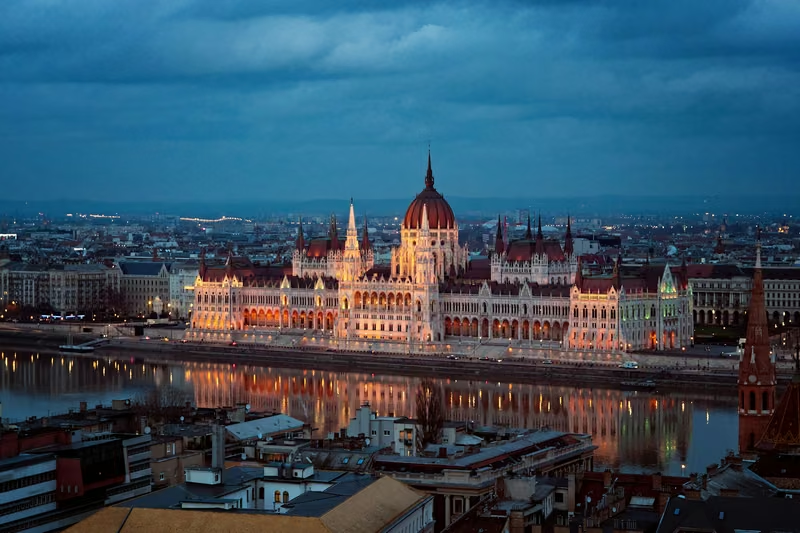
The Danube divides Hungary's capital in two. Hilly Buda, on the west bank, is home to the Castle District, where the Royal Palace, the Matthias Church and the Fishermen's Bastion look across the water. Flat Pest, on the east bank, is the commercial heart of the city, with the neo-Gothic Parliament, St Stephen's Basilica and the elegant Andrássy Avenue, itself part of a UNESCO World Heritage Site. The two towns were only officially united, along with Óbuda, in 1873. Sailing into Budapest is one of the great moments of any Danube cruise, and the riverfront is beautifully lit at night.
Bridges, museums and baths
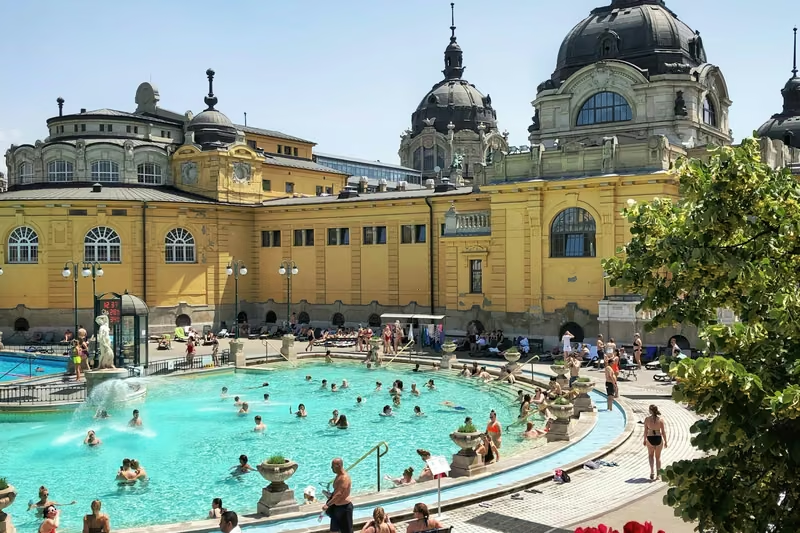
On your second day, you can explore at your own pace. The Chain Bridge, opened in 1849 and designed by the Englishman William Tierney Clark, was the first permanent link between Buda and Pest, and walking across it gives you fine views of both banks. Budapest has good museums, including the Hungarian National Gallery in the Royal Palace. It is also a city of spas, with dozens of thermal springs beneath it. The Gellért Baths are known for their art nouveau interiors, while the Széchenyi Baths in City Park are the place to see locals playing chess in the warm water.
The battlefield of 1526
Mohács is a quiet town in southern Hungary, but its name carries great weight in Hungarian history. On 29 August 1526, an Ottoman army under Suleiman the Magnificent defeated the Hungarian forces here in a matter of hours. King Louis II drowned while fleeing, and much of Hungary came under Ottoman rule for the next 150 years. Hungarians still say more was lost at Mohács when something goes badly wrong. A memorial park now marks the battlefield. The town is also famous for Busójárás, a winter carnival with fearsome wooden masks, which is listed by UNESCO as intangible cultural heritage.
Vučedol, Vukovar and Ilok wine
Just outside Vukovar lies Vučedol, which gives its name to the Vučedol culture, a prehistoric society that flourished here around 5,000 years ago. Its best known find is the Vučedol Dove, a small ceramic vessel that has become a symbol of the town, and a modern museum on the riverbank tells the story. You can also learn about Vukovar's ordeal in 1991, when it endured a siege of almost three months during the Yugoslav Wars. Later you continue to Ilok, Croatia's easternmost town, set on a hill above the Danube with views across to Serbia. Ilok has a long tradition of winemaking, and its Traminac is said to have been served at Queen Elizabeth II's coronation in 1953.
Novi Sad and Petrovaradin
Novi Sad is Serbia's second city and the capital of the Vojvodina region, a relaxed place with a pretty, pedestrianised centre. It was European Capital of Culture in 2022. You can visit one of the city's museums or take in the view from Petrovaradin Fortress across the river, a huge Habsburg stronghold built mainly in the 18th century and sometimes called the Gibraltar of the Danube. Its clock tower has a curious feature, with the hands reversed so the large hand shows the hour and boatmen could read it from the river. Each summer the fortress hosts EXIT, one of the best known music festivals in this part of Europe.
Belgrade
Serbia's capital grew up where the Sava joins the Danube, and the Kalemegdan Fortress on the ridge above has watched over that meeting point since Roman times. Today the fortress grounds form a large park, with walls, gates and a military museum, and the views over the rivers are superb at sunset. You might also see the Church of St Sava, one of the largest Orthodox churches anywhere, with a glittering gold mosaic in its dome. The Square of the Republic, with the statue of Prince Mihailo on horseback, is the place most locals use as a meeting point. Knez Mihailova, the main pedestrian street, links the square to the fortress.
Prehistory and the Iron Gate
Donji Milanovac sits within Đerdap National Park, close to the Iron Gate gorges. Nearby is Lepenski Vir, one of the most important prehistoric sites in Europe, where a settlement of fishermen and hunters thrived beside the river more than 8,000 years ago. Its carved stone heads, with strange fish-like faces, are unlike anything else from the period. The site was moved to higher ground when the Iron Gate dam raised the river in the 1970s. Later the ship sails through the Iron Gate itself, where cliffs close in on both sides and the Danube marks the border between Serbia and Romania. Keep your camera ready on deck.
The castle at Vidin
Vidin lies in Bulgaria's northwest corner, on a wide stretch of the river shared with Romania. Its pride is Baba Vida, a fortress raised on the site of the Roman town of Bononia and developed between the 10th and 14th centuries. It is widely regarded as the only completely preserved medieval castle in Bulgaria, with thick walls, towers and a moat. The Ottomans held Vidin for centuries and left their own mark on the town, including a mosque and old gateways in the walls. Around the town you can also see Orthodox churches and the ruins of a once grand synagogue.
The Siege of Pleven
Pleven lies inland from the Danube in northern Bulgaria, and its name is tied to one of the defining events in the country's history. In 1877, during the Russo-Turkish War, Russian and Romanian forces besieged an Ottoman army under Osman Pasha here for almost five months. The fall of Pleven opened the way for the Russian advance and led, in 1878, to Bulgaria's freedom from Ottoman rule after nearly five centuries. You learn about the siege and see the town's monuments, which include a large panorama museum built for the centenary in 1977 and a memorial chapel to the fallen soldiers.
Romania's Black Sea coast
Constanța is Romania's main port on the Black Sea and one of the oldest cities in the country. It began as the Greek colony of Tomis, and the Roman poet Ovid was exiled here by the Emperor Augustus in AD 8, spending his last years writing mournful verses about the cold and the distance from Rome. His statue stands in the square that bears his name. Today you stroll the waterfront and enjoy views over the Old Town. The grand art nouveau casino on the seafront, opened in 1910, is the city's best known landmark, and a fine sight against the sea.
Romania's capital
Bucharest makes a strong first impression. The Palace of Parliament, started in 1984 on the orders of Nicolae Ceaușescu, is one of the largest administrative buildings ever built, and much of the old city was demolished to make room for it and its grand approach. In complete contrast, the Village Museum is a peaceful open-air collection of farmsteads, wooden churches and windmills brought from across Romania. Founded in 1936 by Dimitrie Gusti, it sits by a lake in Herăstrău Park. Seeing both on the same day gives a real sense of the country's history and its rural roots.
Little Paris and its museums
Your final full day explores Bucharest's elegant side. In the late 19th and early 20th centuries, Romania looked to France for its style, and the city's boulevards, villas and its own triumphal arch earned it the nickname Little Paris. The domed Romanian Athenaeum, opened in 1888, is the finest concert hall in the country. Bucharest has a good choice of museums, including the National Museum of Art in the former royal palace and the Museum of the Romanian Peasant, known for its thoughtful displays of folk life. Revolution Square recalls the dramatic days of December 1989 that ended communist rule.
Farewell to Bucharest
After seventeen days and seven countries, your journey ends in Bucharest. It is time to say goodbye to fellow guests and the crew before your flight home. If you would like to carry on travelling, Viking offers a post-cruise extension to Transylvania and Bucharest, a fully guided programme that heads into the Carpathian Mountains and the old Saxon towns, and a stay in Istanbul. Both make a fitting end to a cruise that has followed the old frontier between Central Europe and the Ottoman world for so much of its length. Ask us about either when you book.
Itineraries and shore excursions are set by Viking and can change, and may vary by departure.
The places you will visit
Vienna, the Habsburgs and the waltz
For more than six centuries Vienna was the seat of the Habsburgs, a dynasty whose lands at various times stretched from Spain and the Netherlands to Hungary and the Balkans. The city was twice besieged by Ottoman armies, in 1529 and 1683, and both times it held. After the second siege, the nobility built palaces in the new baroque style, and the city took the shape we recognise today. Empress Maria Theresa reigned from here in the 18th century and gave birth to sixteen children, including Marie Antoinette.
Vienna's musical story is just as rich. Haydn, Mozart and Beethoven made the city the centre of the classical style, and in the 19th century the Strauss family turned the waltz into a craze across Europe. New Year's Day in Vienna still begins with the Philharmonic's waltz concert, broadcast around the world. The city's coffee house culture goes back to the late 17th century, and places like Café Central were where writers, politicians and thinkers gathered. Sitting with a newspaper over a coffee and cake is still very much part of Viennese life.
Mohács, Belgrade and the Ottoman frontier
From the 14th to the 17th century, the Ottoman Empire pushed steadily up the Danube. Belgrade fell in 1521, and five years later the Hungarian army was destroyed at Mohács. Buda was taken soon after, and central Hungary stayed under Ottoman rule until the late 17th century. Along this part of the river, fortresses such as Kalemegdan, Petrovaradin and Golubac changed hands repeatedly as the frontier moved back and forth. The Ottomans also left mosques, bathhouses and a taste for strong coffee, all of which became part of Balkan life.
The tide turned after the failed siege of Vienna in 1683. Habsburg armies retook Buda in 1686 and moved down the Danube, building great fortifications such as Petrovaradin and Osijek's Tvrđa to hold their gains. Serbia rose against the Ottomans in the early 19th century, and Bulgaria won its freedom after the war of 1877 and 1878, in which the Siege of Pleven was a turning point. Following this route from Vienna to Bucharest, you effectively trace that long contest from one end to the other, with each stop adding a chapter.
Croatia's Danube: Vučedol, Vukovar and Ilok
The short Croatian stretch of the Danube, in the region of Slavonia and Syrmia, has some of the richest farmland and history in the country. Around 5,000 years ago the Vučedol culture thrived on the loess bluffs just outside Vukovar, producing fine decorated pottery and early metalwork. Its most famous object, the Vučedol Dove, was found in 1938 and is now a national symbol and once featured on Croatian banknotes. The Vučedol Culture Museum, built into the riverbank near the original site, opened in 2015 and is a fine example of modern museum design.
Vukovar was once a prosperous baroque town, with the Eltz family's palace as its centrepiece. In 1991 it was surrounded and bombarded by the Yugoslav army and Serb forces for almost three months, and much of the town was destroyed. It has been rebuilt with great care, though the shell-scarred water tower remains as a memorial. Upstream, Ilok has made wine since Roman times, and its historic cellars beneath the old castle are still in use. Traminac, an aromatic white, is the local speciality and is well worth tasting.
What is included
Viking prices its river cruises to include most of what you need, so there are few extras to budget for once you are on board.
Return flights
Return flights from London and selected regional airports, with ground transfers included when you fly with Viking.
A shore excursion in every port
One included shore excursion in each port of call, usually a guided walking or coach tour, with optional extras to buy.
All meals on board
Breakfast, lunch and dinner every day you are on board, including al fresco dining on the Aquavit Terrace.
Drinks with lunch and dinner
Beer, wine and soft drinks served with lunch and dinner, plus specialty coffee, tea and bottled water at any hour.
Free Wi-Fi
Wi-Fi is included on board at no extra charge, though speeds can vary as the ship moves along the river.
Port taxes and fees
Port taxes and fees are built into the fare, so there are no extra charges waiting at the end.
Onboard gratuities
Gratuities for the crew on board are included in the fare.
Enrichment and performances
Talks on the history and culture of your route, plus local performers who bring the destinations to life on board.
Your stateroom, the ship and its facilities are covered on our Viking Longships page.
Fares
| Cruise | Duration | From, per person |
|---|---|---|
| Capitals of Eastern Europe, Vienna to Bucharest | 17 days | £4,795 |
Lead-in fare per person, checked in October 2026. Viking's fares change with the date, direction of sailing and stateroom grade, so please email us for live prices and availability on the departure you have in mind.
Interested in the Capitals of Eastern Europe? Email us your preferred month and we will send dates and prices.
Email an enquiry- The best months are May, June and September, when it is warm enough for walking but not too hot. July and August can be very hot on the Hungarian Plain and in Romania.
- With three days at the start and the end of the trip, Vienna and Bucharest are well covered, but Viking also offers extensions to Venice and Zagreb, Prague, Transylvania and Istanbul.
- Some stops, Pleven in particular, involve a coach journey from the river, so expect a few days with longer drives.
- This route suits experienced travellers who enjoy history and have time for a longer trip, and it works well for those who have already cruised the upper Danube.
- Seven countries means several currencies, though cards are widely accepted in the cities. A little local cash is useful for markets and small cafés.
Capitals of Eastern Europe: your questions answered
The fare includes return flights from London and selected regional airports, one shore excursion in every port of call, all onboard meals, beer, wine and soft drinks with lunch and dinner, specialty coffee, tea and bottled water around the clock, free Wi-Fi, port taxes and fees, enrichment lectures, destination performances and onboard gratuities. Ground transfers come with a Viking Air purchase.
Capitals of Eastern Europe sails on a Viking Longship. These ships have river-view staterooms throughout, some with full-size verandas, and an open-air Aquavit Terrace at the bow that is ideal for watching the Danube Bend and the Iron Gate. Over seventeen days, the ship becomes a comfortable floating hotel you never need to unpack from.
Prices start from £4,795 per person. We checked this in October 2026, and fares change depending on the departure date and stateroom category. Email enquiries@rivercruiseworld.co.uk and we will check current fares and availability for the dates you have in mind and talk you through the choice of stateroom.
Spring and early autumn are ideal, with comfortable temperatures for sightseeing. High summer can be hot, especially in Hungary, Serbia and Romania. If you enjoy wine, a September departure has the bonus of harvest time around Ilok and in the Danube vineyards, though exact timings vary from year to year.
You should be happy walking for an hour or two at a time, often on cobbled streets and slopes, particularly at the fortresses in Novi Sad and Belgrade. Some days include coach travel to sights away from the river, such as Pleven. If you have any concerns about mobility, talk to us first and we can look at each day in detail.
Yes. Before the cruise, Viking offers a fully guided Venice and Zagreb extension and a Prague stay, either standard or premium. Afterwards, you can join the fully guided Transylvania and Bucharest extension or spend extra nights in Istanbul. There is also an optional overland excursion to Sofia and northern Bulgaria. Options vary and can change, so ask us for the latest.
The cruise visits five capitals: Vienna, Bratislava, Budapest, Belgrade and Bucharest. Between them you also see smaller towns such as Mohács, Vukovar, Ilok, Novi Sad, Donji Milanovac, Vidin, Pleven and Constanța, plus scenic sailings through the Danube Bend and the Iron Gate gorges.
You might also like
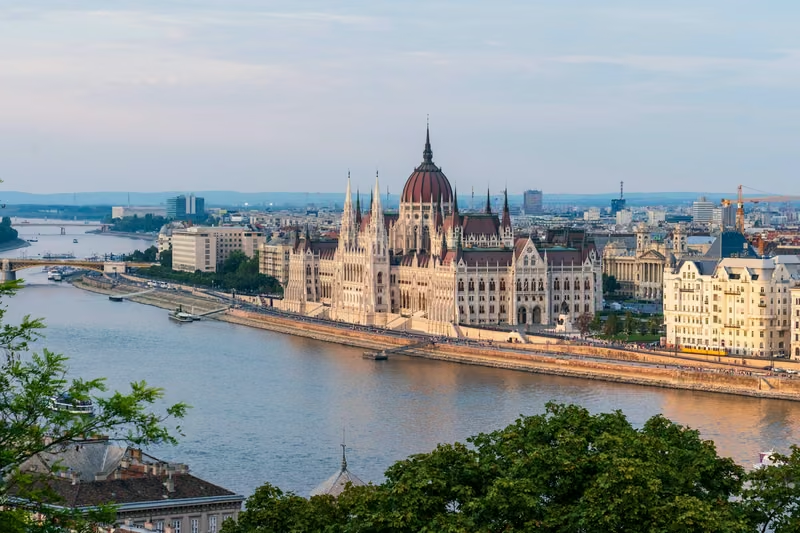
Passage to Eastern Europe
Eleven days on the lower Danube, from Bucharest to Budapest, through the gorges of the Iron Gate and across five countries, several of which most river cruisers never reach.
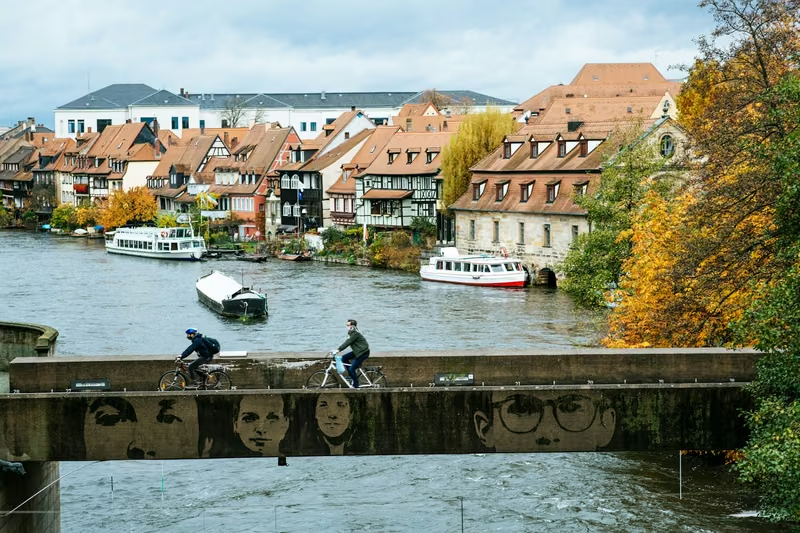
European Sojourn
Twenty-three days and three rivers, from the canals of Amsterdam to the boulevards of Bucharest, crossing eight countries without changing your style of travel.
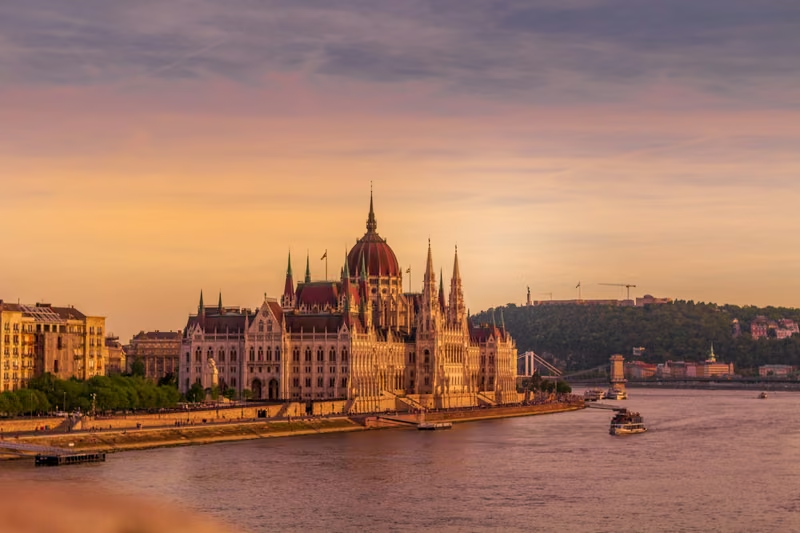
Romantic Danube
Eight days on the Danube from Budapest to medieval Regensburg, with two full days in Vienna and a slow sail through the vineyards of the Wachau.