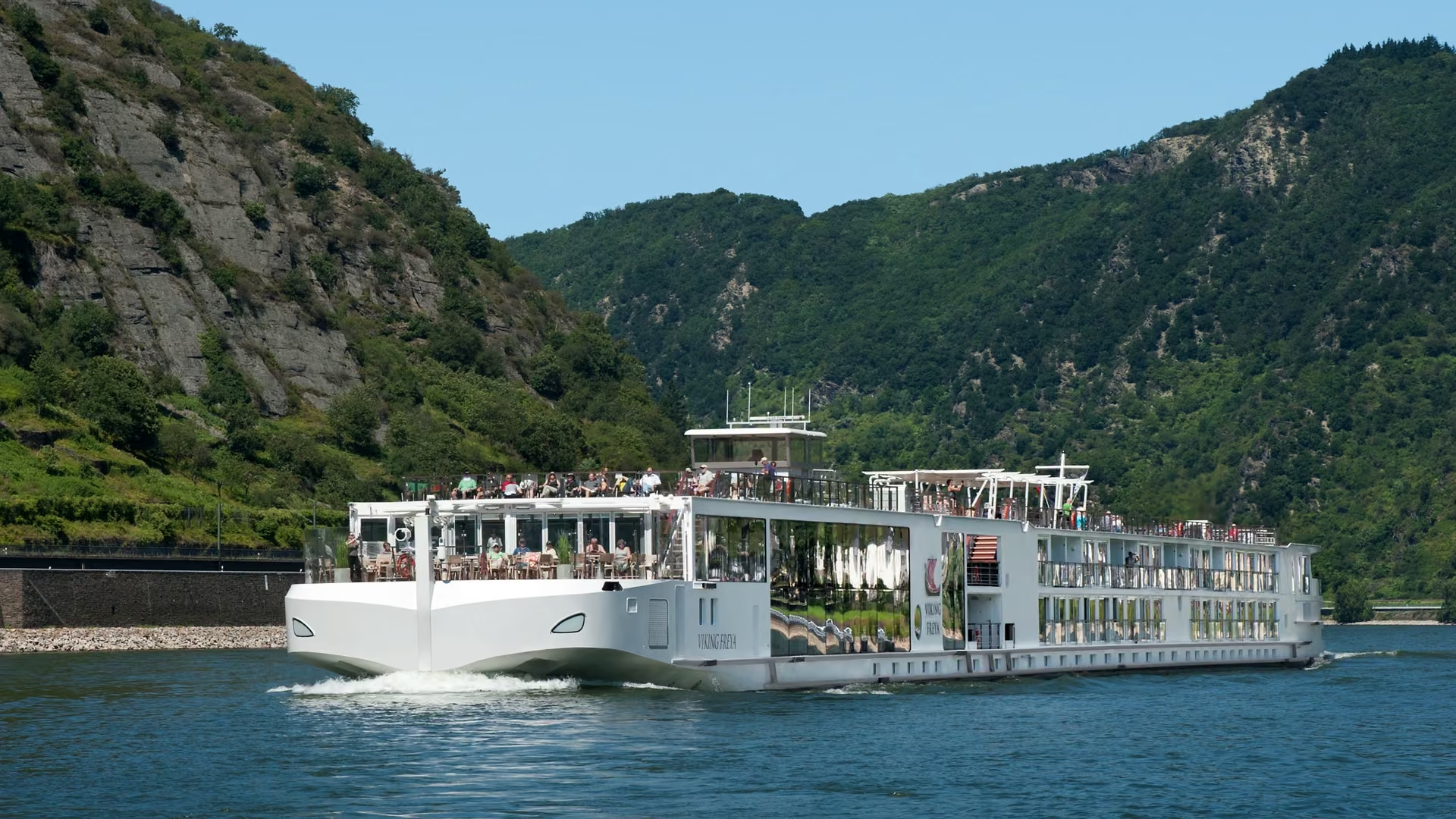
If you like the idea of the Rhine but want something a little quieter too, this is a good choice. The Moselle is narrower and more intimate, with steep vineyards rising straight from the water, and it makes a gentle start before the grander scenery of the Rhine.
The route
Trier · Bernkastel · Cochem · Koblenz · Mainz · Speyer · Strasbourg · Basel
About the Rhine & Moselle Discovery cruise
The cruise begins in Trier, Germany's oldest city, which has more Roman buildings than anywhere else in the country. You have two days here, time to see the Porta Nigra, the great amphitheatre and the Roman baths, before the ship heads down the Moselle to Bernkastel. This is Riesling country, and the steep slate vineyards around the town are some of the most famous in Germany. It is a quiet, very pretty stretch of river, with small wine villages tucked into every loop of the valley.
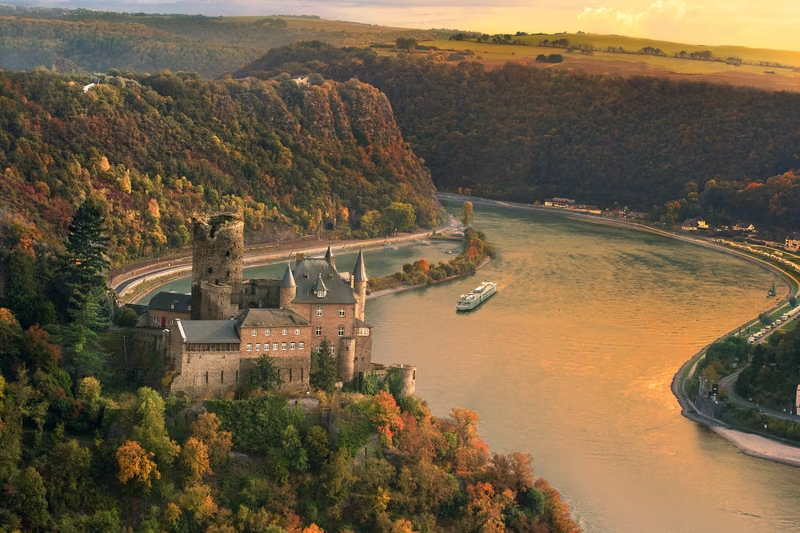
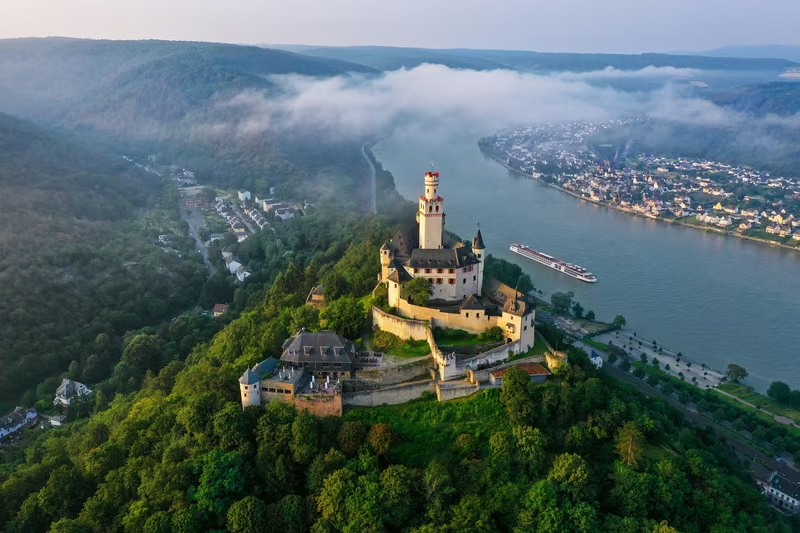
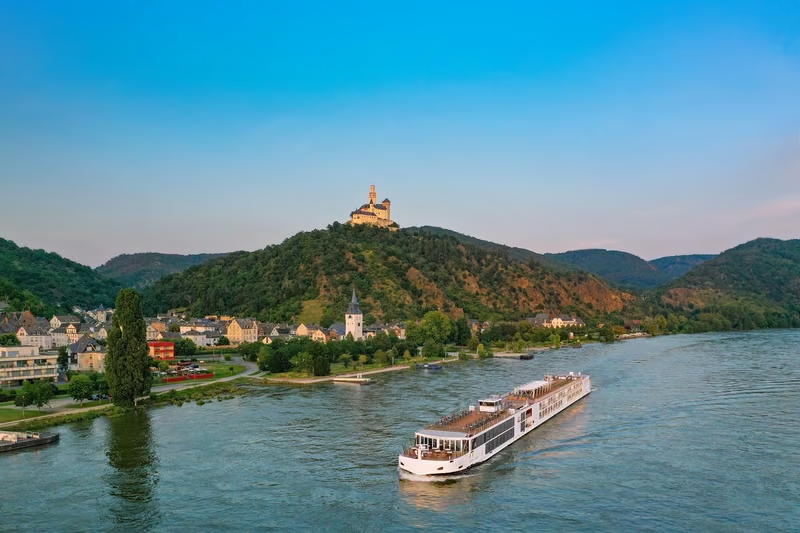
Cochem, with its storybook castle on a hill above the river, is the next stop, and its little lanes and riverside promenade are a pleasure to explore. Then the Moselle meets the Rhine at Koblenz, at the spot known as the German Corner. From here the ship sails south through the Middle Rhine, a UNESCO-listed stretch of castles, vineyards and the famous Lorelei rock. This is the classic Rhine scenery that most people picture, and it is best enjoyed from the sun deck with a coffee in hand.
The second half of the trip is about history and culture. In Mainz you can see one of Gutenberg's original Bibles and taste the city's white wines. Speyer has its huge Romanesque cathedral, the burial place of eight emperors, and Strasbourg brings a taste of France, with its cathedral, its half-timbered old town and its Alsatian cooking. The cruise ends in Basel, on the Swiss border, a cultured city with fine museums and an easy base for exploring more of Switzerland if you would like to stay on.
At eight days, it is a good length for a first river cruise, and it packs in plenty of variety without long days of travel. It suits travellers who enjoy wine, Roman and medieval history and fine scenery, and who would like to see three countries without long journeys between them. Sailing distances are short, so most days give you a good amount of time ashore, and the evenings on board are relaxed. It is also a good way to see the Moselle, which is less visited than the Rhine but every bit as lovely.
For more on the river itself, see our The Main and Moselle river cruise guide, The Rhine river cruise guide.
Cruise highlights
Roman Trier
See the Porta Nigra, the amphitheatre that once held 20,000 spectators, and the remains of the Roman baths in Germany's oldest city.
Moselle Riesling in Bernkastel
Wander the cobbled streets of a half-timbered wine town and taste the vintages of one of Germany's best known wine regions.
Cochem's Reichsburg
Visit the hilltop castle that looks down on the Moselle, then try the mustard made in the town.
The Rhine Gorge
Sail past hilltop castles and steep vineyards through the UNESCO-listed Middle Rhine and look out for the Lorelei rock.
Gutenberg's Mainz
Visit the home city of Johannes Gutenberg, whose museum holds original copies of his Bible, and sample the white wines of the region.
Speyer and Strasbourg
Visit Speyer's Romanesque imperial cathedral, then enjoy Strasbourg's Gothic cathedral and Alsatian food.
Day by day itinerary
Welcome to Trier
Your cruise begins in Trier, which claims to be Germany's oldest city. It was founded by the Romans and later became one of the capitals of the Western Roman Empire. Today you explore some of its highlights, starting with the Porta Nigra, a huge Roman gateway built of dark sandstone blocks without mortar. You also see the Liebfrauenkirche, one of the oldest Gothic churches in Germany, which stands right next to the cathedral. Trier's Roman monuments, cathedral and Liebfrauenkirche are UNESCO-listed. The city is also the birthplace of Karl Marx, and the house where he was born is now a museum.
Roman Trier and the wines of Bernkastel
This morning you go deeper into Trier's Roman past. The amphitheatre, which could hold 20,000 spectators, was used for gladiator fights and animal hunts, and you can still explore the cellars beneath the arena. You also see the Roman baths, among the largest outside Rome. Later the ship sails to Bernkastel, a pretty wine town on the Moselle. Its market square is lined with half-timbered houses, including the narrow Spitzhäuschen, and the surrounding hills are covered with steep vineyards. You will have the chance to taste wines from the region, which is especially known for its Riesling.
Cochem and the Reichsburg
Cochem is one of the prettiest towns on the Moselle, with colourful houses along the river and vineyards climbing the slopes behind. High above the town stands the Reichsburg, a castle that dates back to medieval times. It was destroyed by French troops in 1689 and rebuilt in the 19th century in a romantic neo-Gothic style, which gives it its storybook look today. You visit the castle and see the town's landmarks. Cochem is also known for its mustard, which has been made here for generations, and you can try some during your visit.
Koblenz and the Middle Rhine
Koblenz was founded by the Romans at the point where the Moselle flows into the Rhine. That point is known as the German Corner, and it is marked by a huge equestrian statue of Kaiser Wilhelm I. You explore the Old Town, with its squares, fountains and churches. On the opposite bank, the Ehrenbreitstein fortress looks down on the city. Later the ship sails through the Middle Rhine, a UNESCO-listed stretch of river where steep slopes are covered with vineyards and crowned with castles. Look out for the Lorelei, a tall rock linked to the legend of a siren who lured sailors to their deaths.
Mainz and its white wines
Mainz is the capital of Rhineland-Palatinate and sits across the Rhine from the mouth of the Main. Johannes Gutenberg was born here and developed printing with movable type in the city in the 15th century. The Gutenberg Museum displays original copies of his famous Bible. The red sandstone cathedral has dominated the skyline for around a thousand years. Mainz is also surrounded by Rheinhessen, Germany's largest wine region, and the city has a long tradition of winemaking, especially of high-quality white wines. Today you get a taste of that heritage, with a chance to sample the local wines.
Imperial Speyer
Speyer is a small, pleasant town on the Rhine, dominated by its huge Romanesque cathedral. Consecrated in 1061, it is one of the largest surviving Romanesque churches in Europe, and it was built as a symbol of the power of the Salian emperors. Eight emperors and kings are buried here, which gives the building a special place in German history. The cathedral is UNESCO-listed. Walk from the cathedral along the main street, the Maximilianstrasse, to the Old Gate, one of the tallest town gates in Germany, and stop for a coffee and a slice of cake in one of the cafés.
Strasbourg and Alsatian food
Strasbourg, the capital of Alsace, has changed hands between France and Germany several times, and its culture is a mix of both. Its Gothic cathedral, built from pink sandstone, was the tallest building in the world for over two centuries, and its astronomical clock draws crowds every day. The old town, on an island in the Ill river, is UNESCO-listed, and the Petite France quarter, with its canals and half-timbered houses, is particularly lovely. Alsatian food is hearty and delicious, so try tarte flambée, choucroute or a glass of Riesling. The city is also home to the European Parliament.
Farewell in Basel
Your cruise ends in Basel, on a bend of the Rhine where Switzerland, France and Germany meet. Here you say goodbye to your fellow guests and head home, or stay on to explore. If you have time, Basel is a cultured and attractive city, with a red sandstone cathedral where the scholar Erasmus is buried, a colourful painted town hall and excellent museums, including the Kunstmuseum. Small ferries, pulled across the Rhine by the current, are a fun way to cross the river. Viking offers extensions on some departures, so ask us about the options for your dates.
Itineraries and shore excursions are set by Viking and can change, and may vary by departure.
The places you will visit
Trier, the Rome of the north
Trier was founded by the Romans around 16 BC as Augusta Treverorum, and by the late 3rd century it had become one of the capitals of the Western Roman Empire. Emperor Constantine lived here for several years in the early 4th century, and his great audience hall, now a Protestant church, is one of the largest surviving Roman interiors. The Porta Nigra, built around AD 170, was once one of the city's gates, and owes its survival to being turned into a church in the Middle Ages. The Roman monuments are UNESCO-listed.
The city has much more than its Roman past. Trier Cathedral is said to be the oldest in Germany, with parts dating from Roman times, and the Liebfrauenkirche beside it, built in the 13th century, is one of the earliest Gothic churches in the country. Karl Marx was born here in 1818, and the house where he was born is a museum about his life and ideas. Trier is also in the middle of a wine region, and its wine taverns are a good place to try the local Riesling.
The Moselle, a river of wine
The Moselle rises in the Vosges mountains of France and winds through Luxembourg and Germany before joining the Rhine at Koblenz. In Germany, its valley is lined with some of the steepest vineyards in Europe, where vines grow on slopes of slate that hold the heat of the sun. The Romans planted vines here, and the wine trade has shaped the towns along the river ever since. Riesling is the main grape, and Moselle Rieslings are known for their light, fresh style, often with a touch of sweetness balanced by crisp acidity.
Bernkastel, on one bank of the river, and Kues, on the other, form a single town. Kues was the birthplace of Nicholas of Cusa, a 15th-century cardinal and philosopher, who founded a hospice there that still stands. Bernkastel is famous for the Doctor vineyard, one of the most celebrated in Germany. Further downstream, Cochem's castle was bought in the 19th century by a wealthy Berlin businessman, who rebuilt it as a romantic retreat. Today, the Moselle valley is a popular area for walking, cycling and wine tasting.
Mainz, Gutenberg and the printing revolution
Johannes Gutenberg was born in Mainz around 1400, and in the 1450s he produced the first major book printed in Europe with movable metal type, the Gutenberg Bible. His invention made books much cheaper and quicker to produce, and it helped spread new ideas across Europe, from the Renaissance to the Reformation. The Gutenberg Museum in Mainz, one of the oldest museums of printing in the world, has original copies of the Bible. Its main building closed in 2024 for rebuilding, and the Bibles are shown in a temporary exhibition in the meantime.
Mainz has a long history as a religious and political centre. Its archbishops were among the most powerful figures of the Holy Roman Empire, and they were among the princes who elected the emperor. The cathedral, with its red sandstone towers, has stood for around a thousand years. In the church of St Stephan, the artist Marc Chagall created a series of stunning blue stained glass windows late in his life. Mainz is also famous for its carnival, one of the biggest in Germany, which takes over the city each year.
What is included
Viking prices its river cruises to include most of what you need, so there are few extras to budget for once you are on board.
Return flights
Return flights from London and selected regional airports, with ground transfers included when you fly with Viking.
A shore excursion in every port
One included shore excursion in each port of call, usually a guided walking or coach tour, with optional extras to buy.
All meals on board
Breakfast, lunch and dinner every day you are on board, including al fresco dining on the Aquavit Terrace.
Drinks with lunch and dinner
Beer, wine and soft drinks served with lunch and dinner, plus specialty coffee, tea and bottled water at any hour.
Free Wi-Fi
Wi-Fi is included on board at no extra charge, though speeds can vary as the ship moves along the river.
Port taxes and fees
Port taxes and fees are built into the fare, so there are no extra charges waiting at the end.
Onboard gratuities
Gratuities for the crew on board are included in the fare.
Enrichment and performances
Talks on the history and culture of your route, plus local performers who bring the destinations to life on board.
Your stateroom, the ship and its facilities are covered on our Viking Longships page.
Fares
| Cruise | Duration | From, per person |
|---|---|---|
| Rhine & Moselle Discovery, Trier to Basel | 8 days | £2,395 |
Lead-in fare per person, checked in October 2026. Viking's fares change with the date, direction of sailing and stateroom grade, so please email us for live prices and availability on the departure you have in mind.
Interested in the Rhine & Moselle Discovery? Email us your preferred month and we will send dates and prices.
Email an enquiry- Spring and early autumn are the best times to go; September and October bring the Moselle and Rhine grape harvests and wine festivals.
- Arrive in Trier a day early if you can, as the city's Roman sites are well worth extra time.
- The pace is relaxed, with short sailing distances between stops and plenty of time ashore.
- Cochem's castle is on a steep hill, so allow time for the climb or ask about transport options.
- It is a good first river cruise and pairs well with extra time in Switzerland at the end.
Rhine & Moselle Discovery: your questions answered
Viking's fare includes return flights from London and selected regional airports, one included shore excursion in every port of call, all onboard meals, beer, wine and soft drinks with lunch and dinner, 24-hour specialty coffee, tea and bottled water, free Wi-Fi, port taxes and fees, enrichment lectures and onboard gratuities. Ground transfers are included with Viking flights. Prices start from £2,395 per person, checked in October 2026, and vary with date and stateroom.
The cruise uses one of Viking's European Longships, the modern river ships that sail the Rhine, Main, Moselle and Danube. Every stateroom has a river view, a Viking Explorer bed and a heated bathroom floor. You keep the same stateroom from Trier to Basel, so you only unpack once.
Late spring and early autumn are ideal, with comfortable weather for walking tours. September and October are particularly good for wine lovers, as this is harvest time along the Moselle and the Rhine, and many towns hold wine festivals. Summer is warm and lively, with long evenings on deck.
Most tours involve walking for an hour or two, often on cobbled streets. Cochem's castle sits on a steep hill, and some parts of Trier and Strasbourg involve uneven paving. The ship has a lift between the main passenger decks. If you have mobility concerns, speak to us before booking and we will check the details for you.
Viking includes return flights from London and selected regional airports. The cruise begins in Trier, which is usually reached via a nearby airport, and ends in Basel, whose airport serves both Switzerland and France. We can advise on regional airports and transfer times for your chosen date.
Yes, Viking offers extensions on some departures, and the options vary by date. Basel is a good jumping-off point for the rest of Switzerland, and Lucerne and the Alps are easy to reach by train. Ask us what is available for your chosen departure and we will put together the details.
The cruise visits Trier, Bernkastel and Cochem on the Moselle, then Koblenz, Mainz, Speyer, Strasbourg and Basel on the Rhine, with scenic sailing through the Middle Rhine. It takes in Germany, France and Switzerland, and includes several UNESCO-listed sites, among them Trier, Speyer Cathedral, the Middle Rhine and Strasbourg.
You might also like
A Tale of Three Rivers
Eight days through Germany on the Main, the Rhine and the Moselle, from beer-loving Bamberg to Roman Trier.
Rhine Getaway
Eight days down the Rhine from the Swiss border to the canals of Amsterdam, with Alsace, the castle country of the Middle Rhine and Cologne along the way.
NewCastles, Vineyards & Villages
Eight days from Bavaria to Amsterdam, along the vine-covered Main and through the castle country of the Middle Rhine.