European Sojourn joins two of Viking's best loved cruises into one long voyage. You begin among Dutch windmills, follow the Rhine and Main through Germany, cross to the Danube and keep going all the way to Romania, watching the landscape, food and languages change week by week.
The route
Amsterdam · Kinderdijk · Cologne · Koblenz · Middle Rhine · Miltenberg · Würzburg · Bamberg · Main-Danube Canal · Nuremberg · Regensburg · Passau · Melk · Wachau Valley · Krems · Vienna · Budapest · Kalocsa · Osijek · Belgrade · Golubac · The Iron Gate · Vidin · Ruse · Bucharest
About the European Sojourn cruise
European Sojourn is Viking's 23-day river cruise from Amsterdam to Bucharest, combining the Grand European Tour with Passage to Eastern Europe. You travel on the Rhine, the Main and the Danube, linked by the Main-Danube Canal, and visit eight countries: the Netherlands, Germany, Austria, Hungary, Croatia, Serbia, Bulgaria and Romania. It is about as complete a crossing of the continent as you can make by river, from the North Sea lowlands to the edge of the Black Sea region.
The first half is classic river cruising. You see Kinderdijk's windmills, Cologne's cathedral, the castles of the Middle Rhine, the half-timbered towns of Franconia and the baroque glory of Würzburg, Bamberg and Melk, before reaching Vienna and Budapest. The second half heads into less familiar country, through the Hungarian Plain, eastern Croatia and Belgrade, then the gorges of the Iron Gate and on into Bulgaria and Romania. The contrast between the two halves is part of what makes this trip so rewarding.
You sail on a Viking Longship, where every stateroom has a river view. The fare includes return flights from London and selected regional airports, one shore excursion in every port of call, all meals on board, beer, wine and soft drinks with lunch and dinner, specialty coffee, tea and bottled water at any hour, free Wi-Fi, port taxes and fees, enrichment talks and local performances, and onboard gratuities. Over three weeks, those inclusions make budgeting very straightforward.
Prices start from £7,440 per person. We checked this in October 2026, and fares vary with the departure date and stateroom. This is a trip for people with time to spare who would rather unpack once and see a great deal than fly in and out of separate holidays. Viking offers pre-cruise stays in Amsterdam and post-cruise extensions to Transylvania and Istanbul for those who want even more. If you are weighing this up against the two shorter cruises it is built from, email us and we will set out the differences.
For more on the river itself, see our The Rhine river cruise guide, The Main and Moselle river cruise guide, The Danube river cruise guide.
Cruise highlights
Windmills and canals
Amsterdam's canal ring and the 18th-century windmills of Kinderdijk, both listed by UNESCO, set the scene in the Netherlands.
Castles of the Middle Rhine
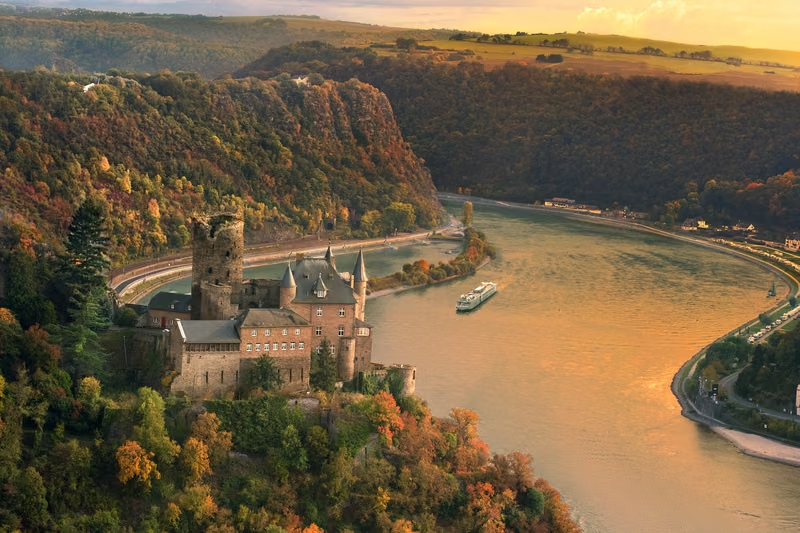
A scenic sailing through the Rhine Gorge past hilltop castles and the Lorelei rock, after a visit to Koblenz's German Corner.
Franconia and the canal
Miltenberg, Würzburg's Residenz and Bamberg's smoked beer, then the locks of the Main-Danube Canal.
The Wachau and Vienna
Melk Abbey, the vineyards of the Wachau Valley, Göttweig Abbey and two days in the Austrian capital.
Budapest to Belgrade
Two days in Budapest, paprika and Puszta horsemen in Kalocsa, a family visit in Croatia and the Kalemegdan Fortress.
Iron Gate and the lower Danube
The dramatic Iron Gate gorges, medieval Vidin and elegant Ruse before your final stop in Bucharest.
Watch the European Sojourn cruise
Video: European Sojourn (Viking Cruises)
Day by day itinerary
Welcome to Amsterdam
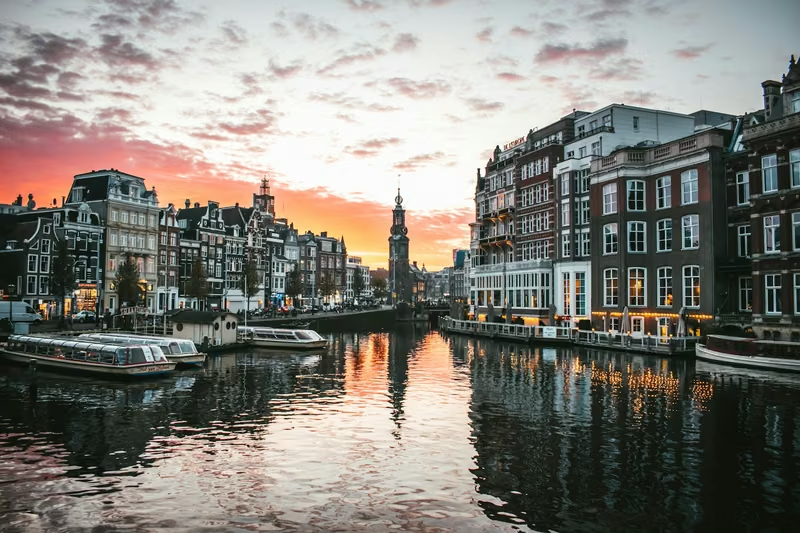
Your long journey begins in the Dutch capital. Amsterdam's 17th-century canal ring, laid out during the Dutch Golden Age, is a UNESCO World Heritage Site, and seeing it from the water is the best introduction to the city. Tall, narrow merchants' houses lean slightly over the canals, many with hoisting beams at the top for lifting goods. You might prefer to visit one of the city's museums instead. The Rijksmuseum holds Rembrandt's The Night Watch and fine works by Vermeer, the Van Gogh Museum has the world's largest collection of his paintings, and the Anne Frank House tells a moving story in the rooms where she hid.
Windmills and waterways
Kinderdijk shows you the Netherlands of the postcards. Nineteen windmills, built around 1740, stand along the drainage channels here to keep the low-lying polders dry, and the site has been listed by UNESCO since 1997. A few are still lived in, and you can see how the millers and their families managed in such compact homes. The landscape here is a reminder of how much of the country has been won from the water over the centuries. Afterwards, the ship sails along the Waal and the Merwede, busy working rivers that form part of the Rhine delta, as the flat Dutch countryside slips past.
Cologne and its cathedral
Cologne was founded by the Romans and grew into one of the largest cities of medieval Germany. Its great Gothic cathedral was begun in 1248 to house the relics of the Three Kings, but it was not finished until 1880, more than six centuries later. Remarkably, it survived the bombing of the Second World War while much of the city around it was destroyed. Today you stroll through the rebuilt Old Town with its narrow lanes and riverside squares. Cologne is also the home of eau de Cologne, and of Kölsch, a light beer served in small glasses that waiters keep topping up until you put a beer mat on top.
German Corner and the Rhine Gorge
Koblenz stands where the Moselle flows into the Rhine, and the point between them is known as the Deutsches Eck, or German Corner. A huge equestrian statue of Kaiser Wilhelm I watches over it, and on the opposite bank the Ehrenbreitstein Fortress looks down from its cliff. You explore the Old Town with its churches and squares. Later the ship sails into the Middle Rhine, a UNESCO-listed stretch of steep vineyards and castle-crowned hills. Watch for the Lorelei rock, where legend says a siren lured boatmen to their deaths, a story made famous by Heinrich Heine's poem.
Into Franconia
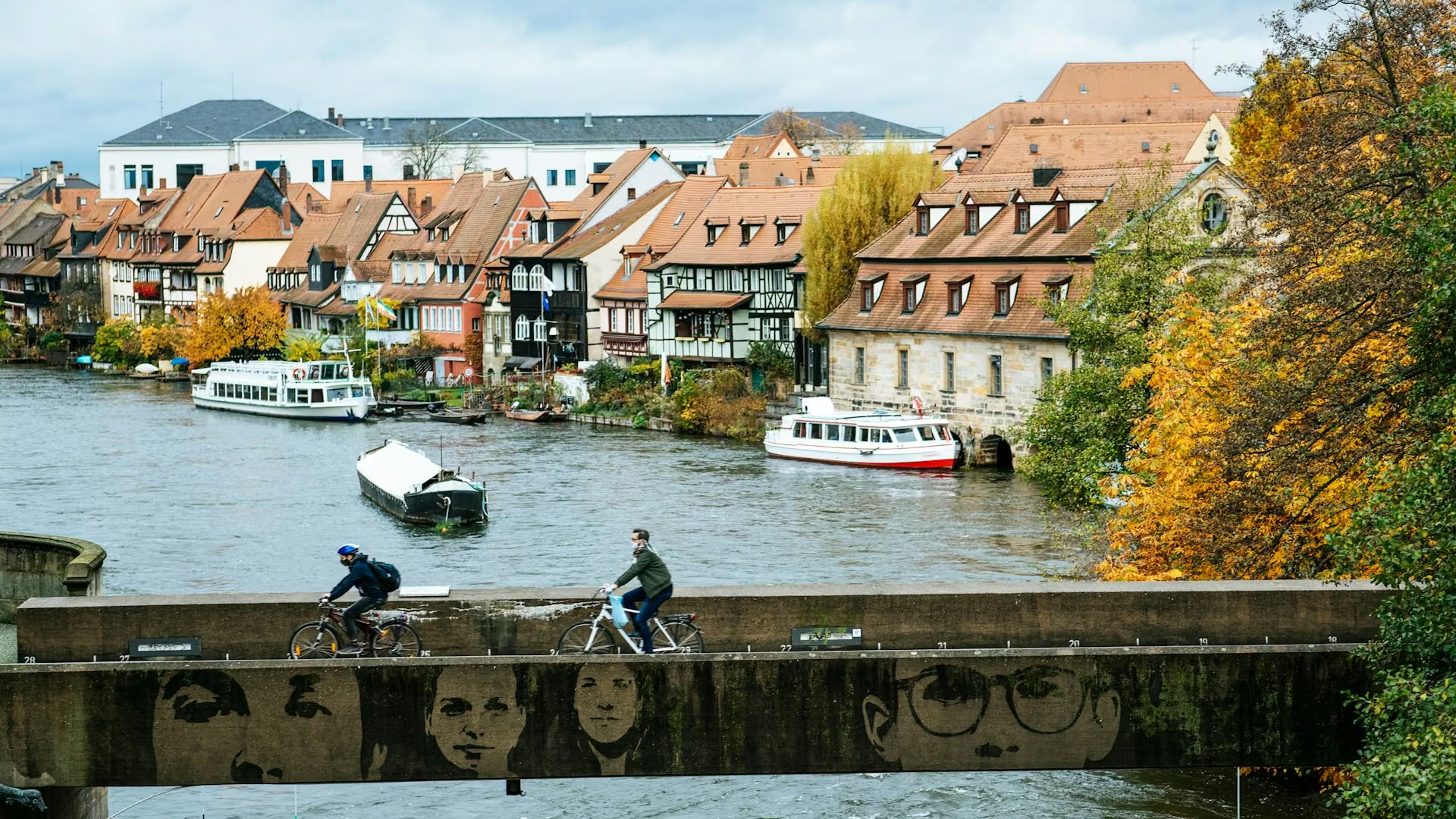
Today you leave the Rhine behind and sail up the Main River through the Spessart, a large wooded upland on the edge of Franconia. It is a relaxing morning, ideal for time on deck. The forests here are the setting of many old folk tales, and the town of Lohr am Main, further upstream, even claims to be the original home of Snow White. In the afternoon you reach Miltenberg, a beautifully preserved town of half-timbered houses squeezed between the river and the hills. The little square known as the Schnatterloch, overlooked by the castle, is one of the prettiest corners in this part of Germany.
Würzburg and the Residenz
For centuries Würzburg was ruled by powerful prince-bishops, and their 18th-century palace, the Residenz, is one of the finest baroque buildings in Europe. It was designed largely by Balthasar Neumann, and its grand staircase is crowned by a vast ceiling fresco painted by the Venetian artist Giovanni Battista Tiepolo, showing the four continents then known to Europeans. The Residenz has been a UNESCO World Heritage Site since 1981. Würzburg is also the centre of Franconian wine, much of it dry Silvaner sold in the distinctive flat, round bottle called a Bocksbeutel. The Old Main Bridge, lined with statues of saints, is a popular spot for a glass at sunset.
Bamberg and the canal
Bamberg escaped serious damage in the Second World War, and its old town, built over seven hills like Rome, is listed by UNESCO. Its most photographed building is the Old Town Hall, perched on an island in the Regnitz river. Legend has it the bishop refused to give the townspeople land for it, so they built it in the water instead. Bamberg is famous for rauchbier, a smoked beer made from malt dried over beech wood fires, with a flavour some compare to bacon. Afterwards the ship enters the Main-Danube Canal, a feat of engineering with 16 locks running 106 miles between Bamberg and Kelheim, which links the North Sea to the Black Sea.
Nuremberg's long history
Nuremberg was one of the great cities of the Holy Roman Empire, and its Imperial Castle still dominates the old town from its sandstone ridge. The painter Albrecht Dürer was born here in 1471, and his house can be visited. Today you see the Market Square with its Gothic Beautiful Fountain, and the Palace of Justice, where Nazi leaders were tried by the Allies in 1945 and 1946 in Courtroom 600. The city's 20th-century history is confronted openly here, which makes a visit thought-provoking. Before you leave, try the small Nuremberg sausages grilled over beech wood, or Lebkuchen, the spiced gingerbread the city has made for centuries.
Medieval Regensburg
Regensburg began as a Roman fortress, Castra Regina, founded in AD 179, and later became one of the richest trading cities in medieval Germany. Its old town, listed by UNESCO in 2006, is one of the best preserved in the country, with tall towers built by wealthy merchant families. The Stone Bridge across the Danube was completed in the 12th century and was a marvel of its age. Next to it, the Historic Sausage Kitchen has been serving travellers for centuries and is often described as the oldest of its kind. The Gothic cathedral is home to the Regensburger Domspatzen, a boys' choir with a history going back over a thousand years.
The City of Three Rivers
Passau sits at the point where the Inn and the little Ilz meet the Danube, and on a sunny day you can see the different colours of the waters running side by side. The old town fills a narrow peninsula between the rivers, its streets lined with Italianate patrician houses rebuilt after a great fire in the 17th century. St Stephen's Cathedral is a baroque masterpiece with a richly stuccoed interior and one of the largest church organs in the world. Passau has long been an important bishopric, and its prince-bishops once ruled lands far into what is now Austria.
Melk, the Wachau and Göttweig
This is a full and beautiful day in Austria. Melk Abbey, a Benedictine monastery rebuilt in grand baroque style between 1702 and 1736 by Jakob Prandtauer, stands high above the river, and its library and ceiling frescoes are superb. Umberto Eco borrowed its name for Adso of Melk in The Name of the Rose. The ship then sails through the Wachau Valley, a UNESCO-listed landscape of terraced vineyards, apricot orchards and riverside villages. Near Krems you visit Göttweig Abbey, founded in 1083, whose imperial staircase is crowned by a ceiling fresco painted by Paul Troger in 1739. Its library and church are equally impressive.
Music and architecture in Vienna
Vienna was the seat of the Habsburg emperors for more than six centuries, and its architecture still speaks of that power. The Ringstrasse, the boulevard laid out from 1857 on the line of the old walls, is lined with the State Opera, the Parliament, the City Hall and the great museums. Today you admire these buildings and learn how Vienna became a world capital of music. Haydn, Mozart, Beethoven and Schubert all worked here, and the Strauss family made the waltz the sound of the city. Johann Strauss II's Blue Danube, first performed in 1867, is a fitting soundtrack for this part of the voyage.
Viennese delights
Your second day in Vienna is yours to shape. You could visit the Kunsthistorisches Museum for its Bruegels and Velázquez portraits, see Klimt's The Kiss at the Belvedere, or tour Schönbrunn, the Habsburgs' summer palace. Vienna's coffee houses are made for a long, unhurried break, with a newspaper on a wooden holder and a glass of water served alongside every coffee. Sachertorte, created by Franz Sacher in 1832, is the famous choice, but the apple strudel and the many cream cakes are just as good. In the evening, a concert of Mozart or Strauss makes a lovely end to your time here.
Arriving in Budapest
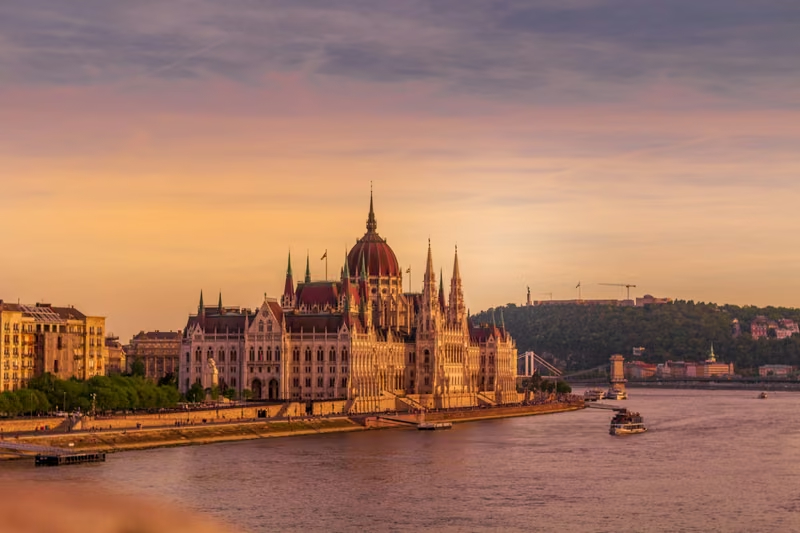
The approach to Budapest by river is one of the finest sights of the whole voyage, with Parliament on one bank and the Royal Palace on the other. The city is really two towns, joined with Óbuda in 1873. On the Buda side, the Castle District holds the palace, the Matthias Church and the Fishermen's Bastion, whose white turrets look out over the Danube. On the Pest side, the neo-Gothic Parliament, finished in 1904, faces the water, with the busy streets and grand avenues of the modern city behind it. After dark, the whole riverfront is lit up and looks magical from the ship.
Bridges and thermal baths
A second day in Budapest leaves time to explore. Walk across the Chain Bridge, opened in 1849 as the first permanent bridge between Buda and Pest and designed by the Englishman William Tierney Clark. Browse one of the many museums, from the National Gallery in the palace to the Hungarian National Museum. Or try a thermal bath, as the city sits above dozens of natural hot springs. The Széchenyi Baths in City Park are vast and lively, while the Gellért Baths are famous for their art nouveau interiors. The Great Market Hall is the place for paprika, salami and other edible souvenirs.
Paprika country
South of Budapest the Danube crosses the Great Hungarian Plain, and Kalocsa is one of the country's two great paprika centres, along with Szeged. You sample food flavoured with the spice and learn how central it is to Hungarian cooking, from goulash to chicken paprikash. Kalocsa has been the seat of an archbishop since around the year 1000, in the time of King Stephen, and it is known for its colourful embroidery and painted folk interiors. Later you watch a Puszta horsemanship show, where skilled riders called csikós show off the riding traditions of the plain.
A taste of Slavonia
Today brings you into Slavonia, the farming region of eastern Croatia. In Osijek, which stands on the Drava near its meeting with the Danube, you see the Tvrđa, a baroque fortress town built by the Habsburgs in the early 18th century after the Ottomans left. A visit to a local family gives you a chance to see everyday life and enjoy some home hospitality, which guests often say is a highlight. In Vukovar you admire the town's buildings and the baroque Eltz Palace, now its museum. The town was badly damaged in a long siege in 1991, and it has been rebuilt with care.
Serbia's capital
Belgrade grew up where the Sava meets the Danube, and the Kalemegdan Fortress above the confluence has been fought over by Romans, Byzantines, Hungarians, Ottomans and Austrians. Today its walls enclose a large and popular park, with sweeping views over both rivers. You might choose instead to see the Church of St Sava, one of the largest Orthodox churches in the world, with a dazzling gold mosaic dome. Or head for the Square of the Republic and its statue of Prince Mihailo, the city's favourite meeting place. In the evening, the cobbled street of Skadarlija is known for its old taverns and live music.
Golubac and the Iron Gate
Golubac Fortress stands where the Danube enters its great gorges, its towers stepping up the rocky hillside from the water's edge. Built in the 14th century, it was fought over by Hungarians, Serbs and Ottomans for generations, and a major restoration was completed in 2019. You learn about its history and enjoy the river views. Afterwards the ship sails through the Iron Gate, where the Danube cuts between the Carpathian and Balkan mountains and forms the border between Serbia and Romania. Watch out for the carved face of the Dacian king Decebalus on the Romanian bank and the Roman Tabula Traiana on the Serbian side.
Vidin and Baba Vida
Vidin sits in Bulgaria's northwest corner on a wide bend of the river. Its best known landmark is Baba Vida, a fortress built on the remains of the Roman town of Bononia and developed between the 10th and 14th centuries. It is often called the only fully preserved medieval castle in Bulgaria, with sturdy towers, thick walls and a moat. Later the Ottomans used it as an arsenal and prison. The town's mix of churches, a mosque and the shell of a once grand synagogue reflects the different communities that have made their home here. It is a relaxed and friendly place to explore.
Elegant Ruse
Ruse is Bulgaria's largest Danube port, and after the country gained its freedom from the Ottomans in 1878 it grew quickly as a gateway to Western Europe. Architects from abroad filled the centre with neo-baroque and neo-rococo buildings, which is why it is often called Little Vienna. The writer Elias Canetti, winner of the Nobel Prize for Literature in 1981, was born here. Today you admire the architecture and sample Bulgarian food, which might include shopska salad, banitsa pastry and the country's famous yoghurt. Not far from the town are the rock-hewn churches of Ivanovo, a UNESCO World Heritage Site known for their medieval frescoes.
Romania's capital
Your last stop is Bucharest, a capital of extremes. The Palace of Parliament, begun in 1984 under Nicolae Ceaușescu, is one of the largest administrative buildings in the world, and a large part of the old city was cleared to build it. The scale is hard to believe until you stand in front of it. In complete contrast, the Village Museum in Herăstrău Park is a peaceful open-air collection of farmhouses, churches and windmills from all over Romania, founded in 1936 by Dimitrie Gusti. Together they make a fascinating final day and a fitting end to a voyage across the continent.
Journey's end
After twenty-three days, three rivers and eight countries, your European Sojourn comes to an end. It is time to say goodbye to your fellow guests and the crew, who will feel like old friends by now, before your flight home. If you are not quite ready to stop, Viking offers a fully guided post-cruise extension to Transylvania and Bucharest, with its mountain scenery and old Saxon towns, or a stay in Istanbul. Either one rounds off the trip nicely, and Istanbul in particular makes a fitting finale after so many days following the old Ottoman frontier.
Itineraries and shore excursions are set by Viking and can change, and may vary by departure.
The places you will visit
The Rhine Gorge and the Romantic Rhine
The stretch of the Rhine between Bingen and Koblenz, where the river cuts a deep valley through the slate hills, was listed by UNESCO in 2002. For centuries it was one of Europe's most important trade routes, and the local lords built castles on almost every height to collect tolls from passing boats. Some, like Marksburg, have survived intact. Others were ruined in the wars of the 17th century and later rebuilt as romantic residences by Prussian princes and wealthy industrialists in the 19th century, when the Rhine became fashionable with artists and travellers.
British visitors played their part in that fashion. J. M. W. Turner sketched and painted the Rhine on several trips, and Lord Byron wrote about the castle of Drachenfels in Childe Harold's Pilgrimage. The Lorelei rock, at one of the narrowest and most dangerous bends in the river, inspired Heinrich Heine's poem of a golden-haired siren whose song lured boatmen onto the rocks. Today the slopes are planted with Riesling vines, and the villages of the gorge, with their half-timbered houses and wine taverns, are as pretty as ever.
Franconia and the Main-Danube Canal
Franconia, the northern part of Bavaria, has its own dialect, food and wine, and locals are quick to tell you they are Franconian before they are Bavarian. Würzburg, Bamberg and Nuremberg were all great powers in their day, ruled respectively by prince-bishops, bishops and city councillors answering only to the emperor. The region's wines, mostly dry whites from Silvaner and Müller-Thurgau grapes, come in the flat-sided Bocksbeutel bottle. Its beer culture is just as strong, and Upper Franconia has one of the highest concentrations of small breweries anywhere in the world.
The idea of linking the Rhine and Danube is very old. Charlemagne tried to dig a canal, the Fossa Carolina, in 793, and traces of it survive. King Ludwig I of Bavaria opened a smaller canal in the 19th century, but it was too narrow for modern shipping. The present Main-Danube Canal was completed in 1992, creating a navigable waterway across Europe from the North Sea to the Black Sea. Passing through its locks, with the ship rising and falling a few centimetres from the walls, is one of the more memorable experiences of this route.
From the Habsburg Danube to the Ottoman frontier
As you travel down the Danube, you cross one of the oldest cultural boundaries in Europe. For centuries Vienna was the heart of the Habsburg empire, and Budapest became its second capital after the compromise of 1867 created Austria-Hungary. South of Budapest, though, much of the land was under Ottoman rule from the 16th century until the late 17th, and Serbia and Bulgaria stayed Ottoman for far longer. The fortresses you see at Belgrade, Golubac and Vidin were the frontier posts of that long struggle.
Bulgaria and Romania emerged as modern states in the 19th century, and both looked to Western Europe for models. That is why Ruse has its Viennese-style squares and Bucharest its Parisian boulevards. The 20th century brought world wars, communism and, in former Yugoslavia, the conflicts of the 1990s. Today Croatia, Hungary, Bulgaria and Romania are members of the European Union, and Serbia is a candidate. Seeing these countries in turn, after the familiar sights of the Rhine and Austria, gives a real sense of how varied Europe is.
What is included
Viking prices its river cruises to include most of what you need, so there are few extras to budget for once you are on board.
Return flights
Return flights from London and selected regional airports, with ground transfers included when you fly with Viking.
A shore excursion in every port
One included shore excursion in each port of call, usually a guided walking or coach tour, with optional extras to buy.
All meals on board
Breakfast, lunch and dinner every day you are on board, including al fresco dining on the Aquavit Terrace.
Drinks with lunch and dinner
Beer, wine and soft drinks served with lunch and dinner, plus specialty coffee, tea and bottled water at any hour.
Free Wi-Fi
Wi-Fi is included on board at no extra charge, though speeds can vary as the ship moves along the river.
Port taxes and fees
Port taxes and fees are built into the fare, so there are no extra charges waiting at the end.
Onboard gratuities
Gratuities for the crew on board are included in the fare.
Enrichment and performances
Talks on the history and culture of your route, plus local performers who bring the destinations to life on board.
Your stateroom, the ship and its facilities are covered on our Viking Longships page.
Fares
| Cruise | Duration | From, per person |
|---|---|---|
| European Sojourn, Amsterdam to Bucharest | 23 days | £7,440 |
Lead-in fare per person, checked in October 2026. Viking's fares change with the date, direction of sailing and stateroom grade, so please email us for live prices and availability on the departure you have in mind.
Interested in the European Sojourn? Email us your preferred month and we will send dates and prices.
Email an enquiry- Late spring and early autumn are the best times for this long voyage. Summer can be hot in Hungary, Serbia and Romania, while spring and autumn bring cooler evenings on deck.
- European Sojourn combines Viking's Grand European Tour and Passage to Eastern Europe, so if you have done one, the other half alone may suit you better.
- Pack layers and comfortable walking shoes. Over 23 days you will see everything from North Sea breezes to warm Balkan afternoons, and many towns have cobbled streets.
- This is a trip for those with time to spare who like the idea of unpacking once. The pace is steady, with a mix of busy city days and quieter sailing days.
- Viking offers pre-cruise stays in Amsterdam, including a fully guided Best of Holland option, and post-cruise extensions to Transylvania and Istanbul.
European Sojourn: your questions answered
Your fare includes return flights from London and selected regional airports, one shore excursion in every port of call, all onboard meals, beer, wine and soft drinks with lunch and dinner, 24-hour specialty coffee, tea and bottled water, free Wi-Fi, port taxes and fees, enrichment lectures and destination performances, and onboard gratuities. Ground transfers are included with a Viking Air purchase.
You travel on a Viking Longship, Viking's standard river ship design in Europe. All staterooms face the river, and the Aquavit Terrace at the bow is a lovely spot for watching the Rhine Gorge, the Wachau and the Iron Gate. Viking can change ships, so we will confirm the details for your departure when you book.
Prices start from £7,440 per person. We checked this in October 2026, and fares vary by departure date and stateroom category. On a trip of this length, a larger stateroom or a veranda can make a real difference, so email enquiries@rivercruiseworld.co.uk and we will compare the options for you.
Many guests find the length is exactly what makes it special. You only unpack once, the days have a comfortable rhythm, and there are quieter sailing days and free time in the big cities to recharge. If you are unsure, you could start with the Grand European Tour or Passage to Eastern Europe, which together make up this voyage.
Most included tours are walking tours of old towns, often on cobbles and sometimes on hills, such as at Melk, Kalemegdan and Golubac. Some days involve coach transfers. You should be comfortable walking for an hour or two at a time. If you have mobility concerns, talk to us before booking and we can go through each day.
Yes. Viking offers pre-cruise extensions in Amsterdam, including a premium stay and a fully guided Best of Holland programme. After the cruise, you can join a fully guided Transylvania and Bucharest extension or spend extra nights in Istanbul. Options vary and can change, so ask us for the current choices.
You sail on the Rhine, the Main and the Danube, linked by the Main-Danube Canal, with scenic sailings on the Waal and Merwede, the Middle Rhine, the Spessart, the Wachau and the Iron Gate. The eight countries are the Netherlands, Germany, Austria, Hungary, Croatia, Serbia, Bulgaria and Romania.
You might also like
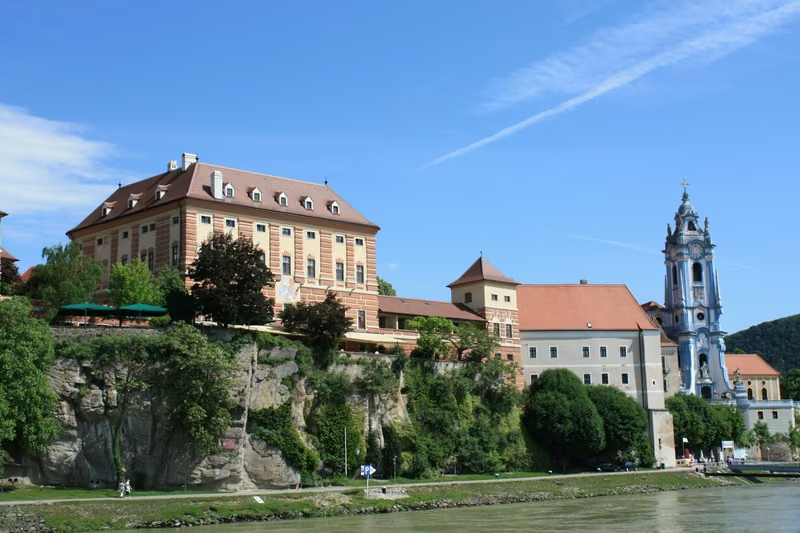
Grand European Tour
Fifteen days across the continent by water, from the bridges of Budapest to the canals of Amsterdam, linking the Danube, the Main and the Rhine.
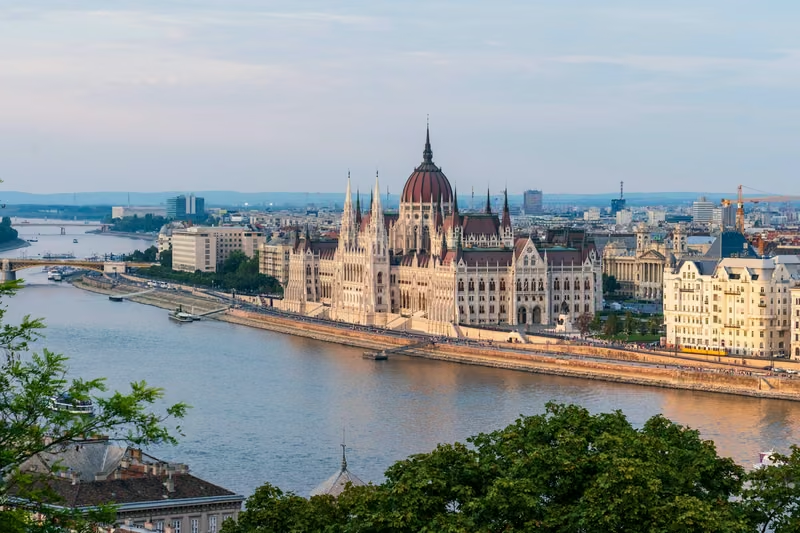
Passage to Eastern Europe
Eleven days on the lower Danube, from Bucharest to Budapest, through the gorges of the Iron Gate and across five countries, several of which most river cruisers never reach.
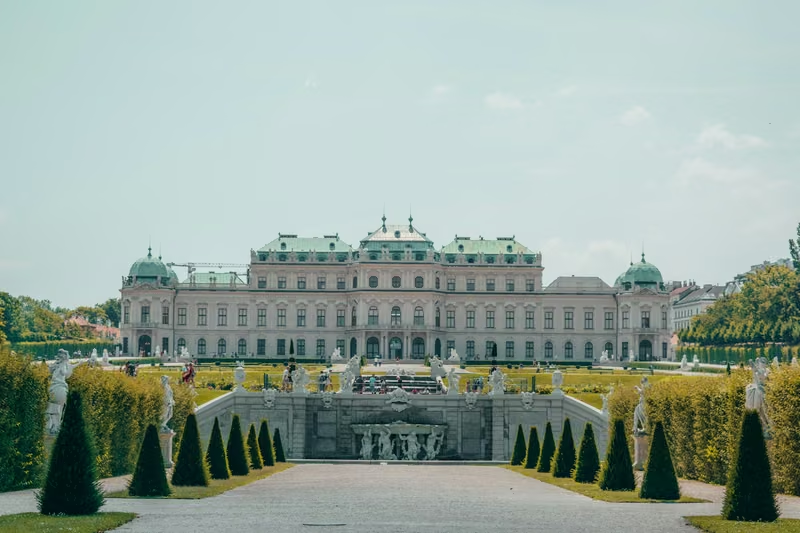
Capitals of Eastern Europe
Seventeen days down the Danube from Vienna to Bucharest, with five capital cities, the Iron Gate gorges and a final run towards the Black Sea.