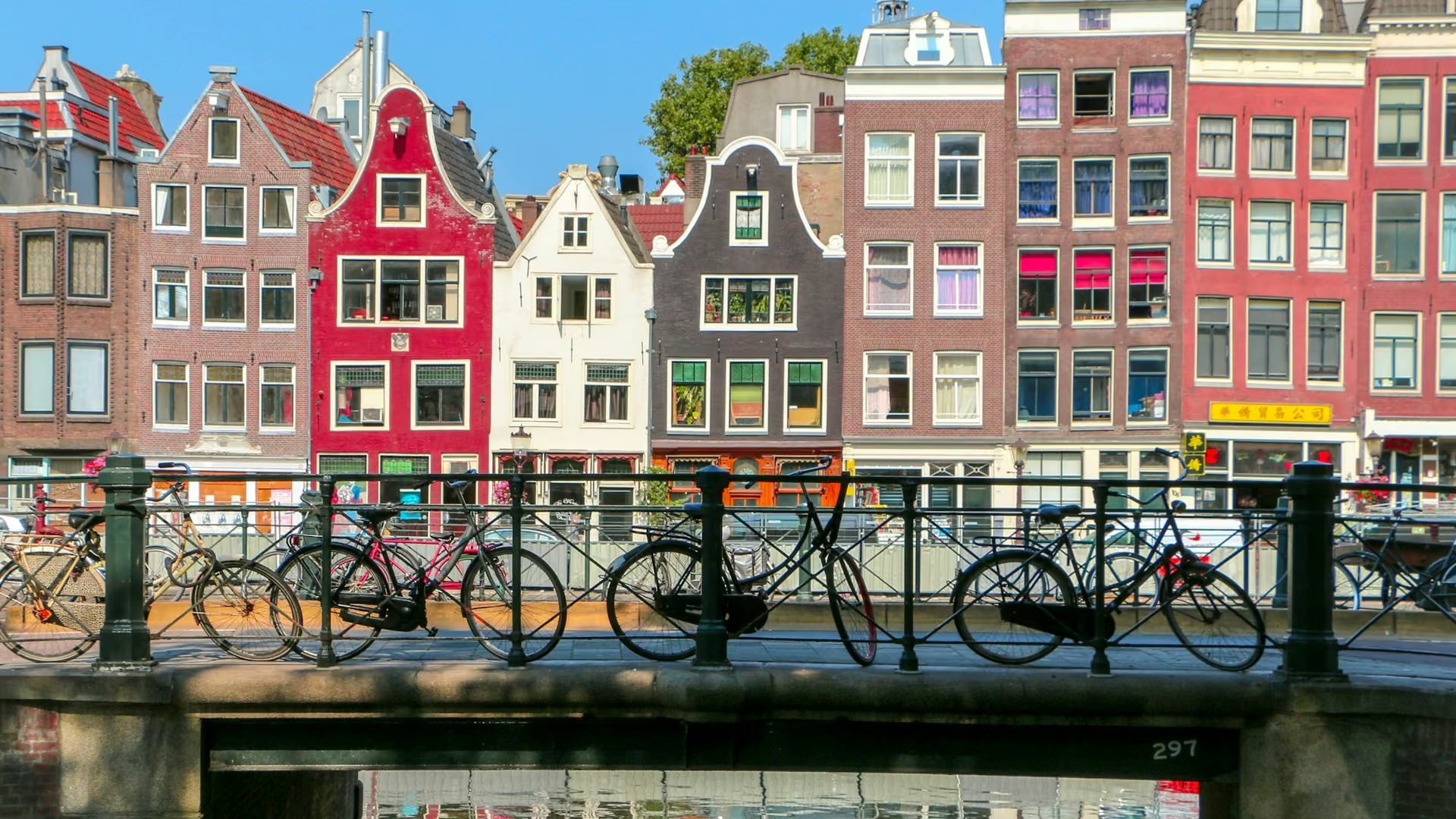
This is a cruise for people who like their history close at hand. The Netherlands is a country made by its waterways, and over ten days you follow the rivers and canals that shaped it, with a short crossing into Germany and a finish in Flemish Antwerp.
The route
Amsterdam · Hoorn · Dordrecht · Rotterdam · Kinderdijk · Gorinchem · Wesel · Nijmegen · Maastricht · Antwerp
About the Holland & Belgium cruise
Holland & Belgium begins with two days in Amsterdam, where your Viking Longship stays overnight. That gives you time to settle in properly: a canal trip one day, a museum the next, and a plate of bitterballen somewhere in between. From there the ship heads north to Hoorn, once a busy port of the Dutch East India Company, before turning south into the delta country around Dordrecht and Rotterdam, where old Holland and the modern Netherlands sit almost side by side.
The middle of the cruise is where it differs from most Low Countries itineraries. After the windmills of Kinderdijk and the star-shaped ramparts of Gorinchem, you cross the border to Wesel on the German Lower Rhine, a Hanseatic trading town that had to be largely rebuilt after 1945. Back in the Netherlands you call at Nijmegen, which can trace its story back 2,000 years to the Romans, and then Maastricht, tucked into the far south between Belgium and Germany.
The final port is Antwerp, Belgium's great trading city and Europe's diamond capital. It is also the city of Rubens, Flemish beer and very good chocolate, and you have a full day there before heading home. Travel in spring and Viking's programme also offers the chance to see Keukenhof Gardens in bright bloom, which is a good reason on its own to choose an April departure if your dates are flexible.
As on all Viking's European Longship cruises, the fare covers return flights from London and selected regional airports, one included shore excursion in every port of call, all meals on board, and beer, wine and soft drinks with lunch and dinner. Free Wi-Fi, port taxes and onboard gratuities are included too. Prices start from £2,995 per person. We checked this in October 2026, and fares change with the departure date and the stateroom you choose.
For more on the river itself, see our Holland and Belgium river cruise guide.
Cruise highlights
Two days in Amsterdam
Your ship stays overnight in the Dutch capital, so there is time for the canals and the city's great museums without rushing.
The windmills of Kinderdijk
A long line of 18th-century windmills standing over the polders, listed by UNESCO and still the classic image of Holland.
Rotterdam reborn
Rebuilt after the bombing of 1940, Rotterdam is the place for bold modern architecture, including the famous tilted cube houses.
A day in Germany
Wesel on the Lower Rhine adds a German chapter, with its Citadel and the rebuilt Willibrordi-Dom and its striking glass window.
Maastricht's southern charm
Cobbled lanes, a 17th-century Town Hall on the Markt and a relaxed, café-loving pace that feels quite unlike the north.
Antwerp to finish
Belgian chocolate, fruit beer and Rubens in a city that has lived on trade for centuries.
Watch the Holland & Belgium cruise
Video: Holland & Belgium (Viking Cruises)
Day by day itinerary
Arrive in Amsterdam
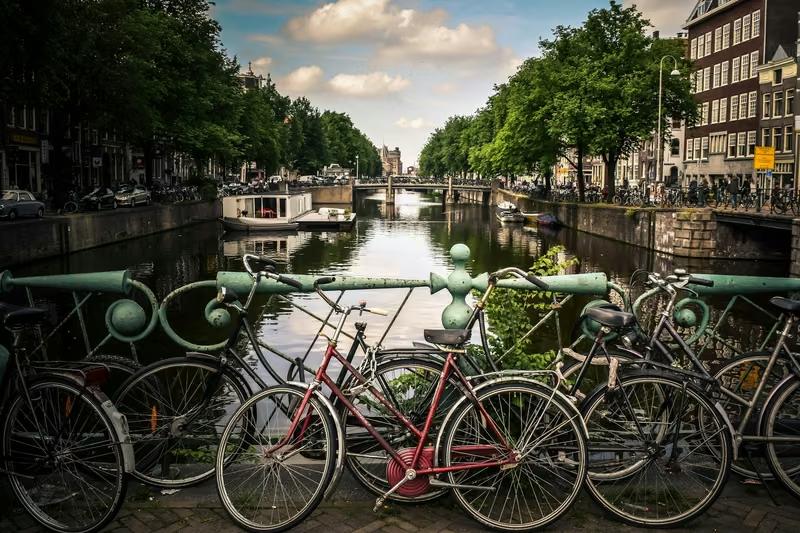
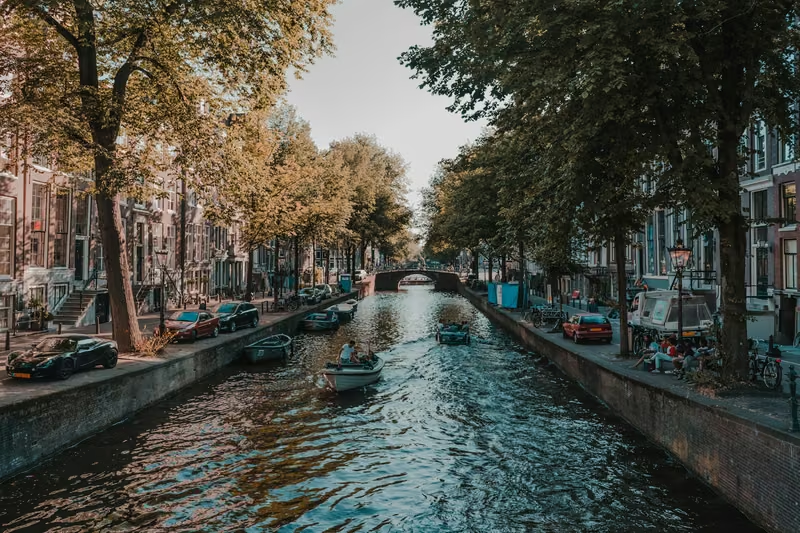
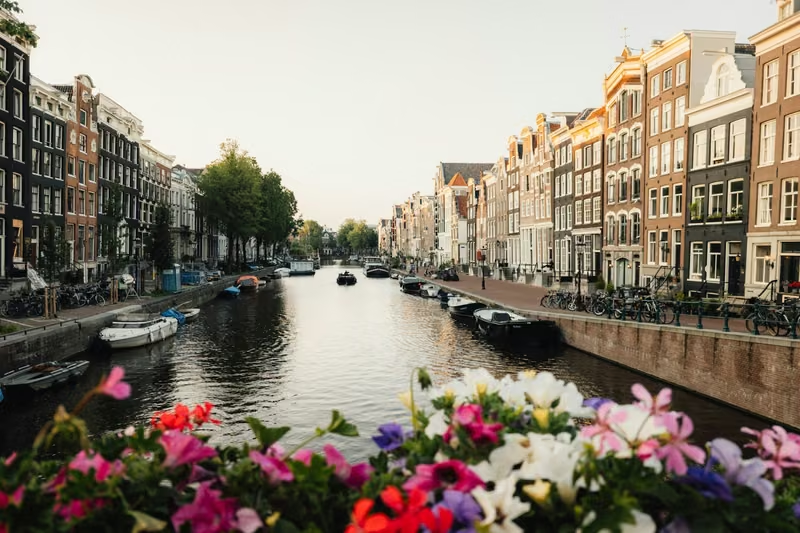
Your cruise begins in the Dutch capital, where you board your Viking Longship and unpack for the next ten days. Amsterdam's ring of 17th-century canals, dug during the Golden Age and now listed by UNESCO, is best seen from the water, and a trip along them is the natural first outing. If you would rather stay on dry land, the city's museums are among the finest in Europe, from the Dutch Masters in the Rijksmuseum to the Van Gogh Museum close by. In the evening, settle into life on board with your first dinner as the lights come on along the waterfront.
A taste of Dutch life
With the ship staying overnight, you have a second day in Amsterdam to explore at your own pace. It is a good day to try the snacks the Dutch are proud of. Bitterballen are small, crisp balls of meaty ragout, fried and served with mustard and usually a cold beer, while poffertjes are tiny, puffy pancakes topped with butter and a dusting of icing sugar. Away from the food stalls, wander the quieter lanes of the Jordaan, browse the flower market on the Singel or simply sit by a canal and watch the bicycles go by.
Hoorn's seafaring past
Hoorn sits on the old Zuiderzee shore, and in the 17th century it was one of the six cities with a chamber of the Dutch East India Company. Its sailors travelled a very long way: in 1616 Willem Schouten rounded the southern tip of South America and named Cape Horn after his home town. The Westfries Museum, in a handsome building from 1632 on the main square, the Roode Steen, tells the story of the town and the surrounding region. Look out too for Hoorn's old cheese warehouses, a reminder that West Friesland has always been dairy country as well as a land of sailors.
Old Holland meets new
Dordrecht was granted city rights in 1220, which is why it is often called the oldest city in Holland, and its harbours and merchants' houses still feel wonderfully lived in. The Grote Kerk dominates the skyline, and its tower holds 67 bells, including a carillon and the largest swinging bell in the country. In 1572 representatives of Holland's towns met here in secret to back William of Orange against Spain, an early step towards an independent Dutch Republic. Later you reach Rotterdam, whose centre was destroyed by bombing in May 1940. The city chose to rebuild boldly, and Piet Blom's tilted cube houses are one of the most memorable results.
Windmills and ramparts
Kinderdijk is the Dutch countryside as everyone pictures it: a line of windmills standing over flat green polders and quiet channels of water. The mills were built in the 18th century to keep the land dry, and the site has been on UNESCO's World Heritage List since 1997, with mills that still turn and some that are still lived in. A short sail brings you to Gorinchem, a fortified town where the Linge meets the Merwede. Its ring of bastions, completed in 1609, survives almost intact, and a walk along the ramparts gives you lovely views over the rooftops and the river.
Into Germany at Wesel
Today you cross into Germany and the Lower Rhine town of Wesel. In the late Middle Ages this was a prosperous member of the Hanseatic League, second only to Cologne as a trading centre on this part of the river. Its later history was harder. Allied bombing in February 1945 destroyed almost the whole town, shortly before British forces crossed the Rhine here that March. Much has since been rebuilt with care, including the grand Citadel and the Gothic Willibrordi-Dom, known for its stunning glass window. Wesel was also the birthplace of Peter Minuit, who bought Manhattan Island for the Dutch in 1626.
Two thousand years of Nijmegen
Nijmegen began life as a Roman settlement, and its 2,000-year history gives it a strong claim to be the oldest city in the Netherlands. The Grote Markt is the place to start, framed by old buildings including the weigh house of 1612, where goods brought to market were once weighed and taxed. Today it is a café, so you can admire its Dutch Renaissance front over a coffee. Nijmegen also played a major part in Operation Market Garden in September 1944, when American and British troops fought for the great road bridge over the Waal. These days it is a lively university city with plenty of terraces.
Maastricht's southern charm
Maastricht feels different from the rest of the Netherlands. It sits on the Maas in the far south, close to both Belgium and Germany, and its food, accent and easy pace owe a good deal to its neighbours. Narrow cobbled streets lead to the Market Square, where the Town Hall designed by Pieter Post was begun in 1659 and opened in 1664. Close by is the Vrijthof, a broad square lined with cafés and overlooked by the Basilica of Saint Servatius. The city gave its name to the 1992 treaty that created the European Union, but most visitors remember it for long lunches and slices of vlaai, the local fruit tart.
Chocolate, beer and Rubens
The ship crosses into Belgium for your final port, Antwerp. This city has grown rich on trade for centuries and is still known as Europe's diamond capital, with a whole district near the Central Station given over to the business. The Cathedral of Our Lady holds great altarpieces by Peter Paul Rubens, who lived and worked here, and the Grote Markt, with its guildhalls and Brabo Fountain, is one of the finest squares in Belgium. It would be rude not to try the chocolate, and a glass of Belgian fruit beer, brewed with cherries or raspberries, makes a fine toast to the end of the cruise.
Farewell to Antwerp
After breakfast it is time to say goodbye to the crew and your fellow guests. If you booked your flights through Viking, your transfer takes you to the airport for the journey home to the UK. If you are not ready to leave, you can stay on and see more of Belgium with one of Viking's extensions. When we checked, the options for this cruise included a couple of extra nights in Brussels or a fully guided stay in Bruges and Ghent, and we are happy to check what is available for your date. With a little time to spare, a last stroll along the Scheldt is a nice way to finish.
Itineraries and shore excursions are set by Viking and can change, and may vary by departure.
The places you will visit
Water, windmills and Dutch engineering
Around a quarter of the Netherlands lies below sea level, and much of the country you sail through on this cruise was once marsh, lake or open water. From the Middle Ages onwards, communities built dykes around low-lying land and pumped it dry, creating the polders that give the landscape its flat, orderly look. Windmills were the engines of that work. At Kinderdijk, a group of nineteen mills built in the 18th century kept the Alblasserwaard polder drained for generations, lifting water step by step into higher channels and out to the river.
Steam, diesel and electric pumping stations eventually took over, but the Dutch never stopped improving their defences. After the North Sea flood of 1953, which killed more than 1,800 people in the Netherlands, the government began the Delta Works, a chain of dams and storm surge barriers across the estuaries of Zeeland and South Holland. Rotterdam's position near the mouths of the Rhine and Maas depends on this kind of careful management, and so does much of the route between Dordrecht and Gorinchem, where several great rivers meet and divide.
Golden Age towns: Amsterdam, Hoorn and Dordrecht
The 17th century was the Dutch Golden Age, when a young republic became one of the richest trading powers in the world. Amsterdam was its commercial capital, and the canal ring, lined with tall, narrow merchants' houses, was laid out to hold the wealth flowing in from the Baltic, the East Indies and beyond. The Dutch East India Company, founded in 1602, was run through chambers in six cities, and Hoorn was one of them. Its ships brought pepper, nutmeg and other spices back across the Zuiderzee, and that money paid for the gabled houses you still see around the harbour.
Dordrecht's moment came a little earlier. The city stood where several rivers meet and controlled much of the trade passing along them, and in 1572 it hosted the meeting of Holland's towns that backed William of Orange in the revolt against Spanish rule. A generation later, the Synod of Dort, held from 1618 to 1619, settled a bitter dispute within the Dutch Reformed Church. Walking these towns today, it is easy to picture the merchants, preachers and sea captains who made them, because so much of their world has been kept rather than replaced.
Maastricht and Antwerp: the southern Low Countries
Maastricht and Antwerp give the cruise a different flavour from the Holland ports. Maastricht grew up at a Roman crossing of the Maas and spent much of its history being fought over by its neighbours, which explains both its old fortifications and its mix of Dutch, Belgian and German influences. The Town Hall by Pieter Post is a fine example of Dutch classical architecture, while the Basilica of Saint Servatius on the Vrijthof is one of the oldest churches in the Netherlands. The city's name is also attached to the Maastricht Treaty, signed here in 1992.
Antwerp was one of the busiest ports in Europe in the 16th century and is still one of the largest today. Its great age of trade left the guildhalls of the Grote Markt, the soaring Cathedral of Our Lady and the Plantin-Moretus printing house, now a UNESCO-listed museum. Peter Paul Rubens made his home here, and several of his most admired paintings hang in the cathedral. The diamond trade, which took root in the 15th century, still fills the streets around Central Station with dealers and cutters, while the chocolatiers and beer cafés keep everyone else happy.
What is included
Viking prices its river cruises to include most of what you need, so there are few extras to budget for once you are on board.
Return flights
Return flights from London and selected regional airports, with ground transfers included when you fly with Viking.
A shore excursion in every port
One included shore excursion in each port of call, usually a guided walking or coach tour, with optional extras to buy.
All meals on board
Breakfast, lunch and dinner every day you are on board, including al fresco dining on the Aquavit Terrace.
Drinks with lunch and dinner
Beer, wine and soft drinks served with lunch and dinner, plus specialty coffee, tea and bottled water at any hour.
Free Wi-Fi
Wi-Fi is included on board at no extra charge, though speeds can vary as the ship moves along the river.
Port taxes and fees
Port taxes and fees are built into the fare, so there are no extra charges waiting at the end.
Onboard gratuities
Gratuities for the crew on board are included in the fare.
Enrichment and performances
Talks on the history and culture of your route, plus local performers who bring the destinations to life on board.
Your stateroom, the ship and its facilities are covered on our Viking Longships page.
Fares
| Cruise | Duration | From, per person |
|---|---|---|
| Holland & Belgium, Amsterdam to Antwerp | 10 days | £2,995 |
Lead-in fare per person, checked in October 2026. Viking's fares change with the date, direction of sailing and stateroom grade, so please email us for live prices and availability on the departure you have in mind.
Interested in the Holland & Belgium? Email us your preferred month and we will send dates and prices.
Email an enquiry- Spring is the most popular time to go, when the bulb fields are in colour and Keukenhof is open. The gardens usually open for around eight weeks from mid-March to mid-May.
- Amsterdam is an easy flight from most UK airports, and because the ship stays overnight you have two full days there before sailing.
- The pace is gentle, with short sailing distances and flat, compact towns that are easy on foot, though you will meet plenty of cobbles.
- The cruise ends in Antwerp, so it is simple to add a few days in Belgium with a Viking extension such as Brussels or Bruges and Ghent.
- It suits first-time river cruisers and anyone who enjoys history, art and engineering more than mountain scenery.
Holland & Belgium: your questions answered
Viking's fare includes return flights from London and selected regional airports, one included shore excursion in every port of call, all meals on board, beer, wine and soft drinks with lunch and dinner, 24-hour specialty coffee, tea and bottled water, free Wi-Fi, port taxes and fees, enrichment lectures and onboard gratuities. Ground transfers are included when you buy your flights through Viking.
Holland & Belgium is sailed by one of Viking's European Longships. The exact ship is confirmed when you book. All Longships follow the same design, with river-view staterooms, the Viking Explorer bed, heated bathroom floors and the Aquavit Terrace at the bow, where you can eat outside and watch the scenery go by.
Spring is the favourite, partly because spring departures offer the chance to see Keukenhof Gardens in full bloom. Tulip season usually peaks around mid-April, though it depends on the weather. Summer brings longer, warmer days and busy café terraces, while early autumn is quieter and still pleasant for walking around the towns.
You do not need to be especially fit. The Netherlands is famously flat, and most of the towns on this route are compact enough to explore on foot. Expect cobbled streets, some uneven paving and a few steps when getting on and off the ship. If you have mobility concerns, tell us before booking and we can talk it through with Viking.
Return flights are included from London and selected regional airports in the UK. You fly out to Amsterdam at the start and home again once the cruise ends in Antwerp. If you buy your flights through Viking, transfers between the airport and the ship are included. We can tell you which regional airports are available for your chosen departure.
Yes. When we checked in October 2026, Viking offered pre-cruise stays in Amsterdam and The Hague, and post-cruise options in Brussels or a fully guided stay in Bruges and Ghent. Extensions and their prices change, so ask us and we will confirm what is available for your dates.
You start with two days in Amsterdam, then call at Hoorn, Dordrecht, Rotterdam, Kinderdijk and Gorinchem. The ship then crosses into Germany for Wesel before returning to the Netherlands for Nijmegen and Maastricht. The cruise ends in Antwerp, Belgium, with a full day there before you head home.
You might also like
Tulips & Windmills
A spring round trip from Amsterdam through the Dutch waterways and into Belgium, timed for the tulips, the windmills and the long light evenings.
Rhine Getaway
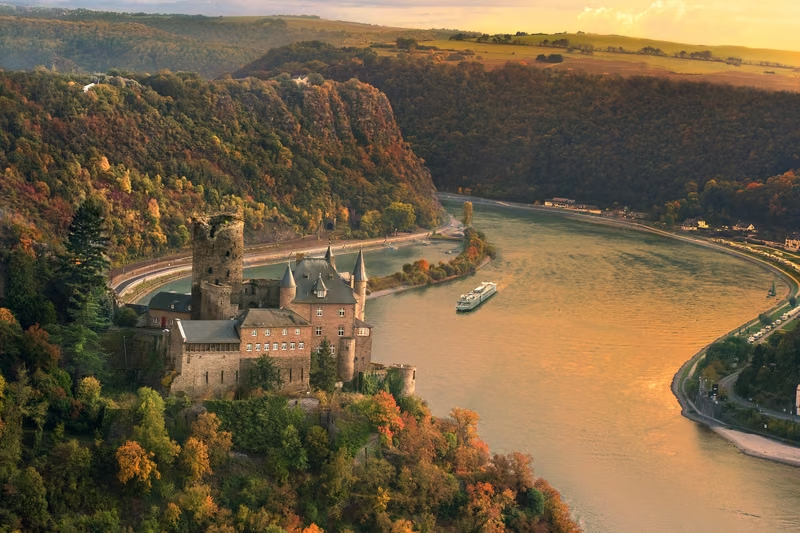
Eight days down the Rhine from the Swiss border to the canals of Amsterdam, with Alsace, the castle country of the Middle Rhine and Cologne along the way.
 New
Castles, Vineyards & Villages
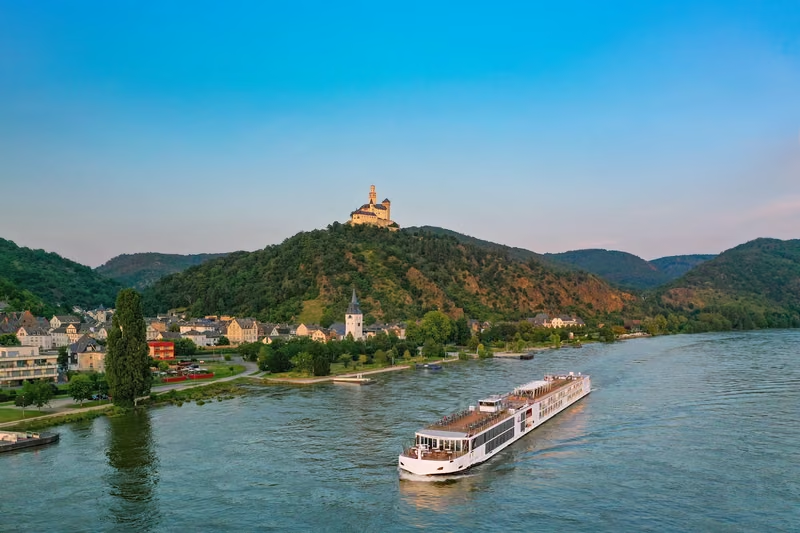
Eight days from Bavaria to Amsterdam, along the vine-covered Main and through the castle country of the Middle Rhine.