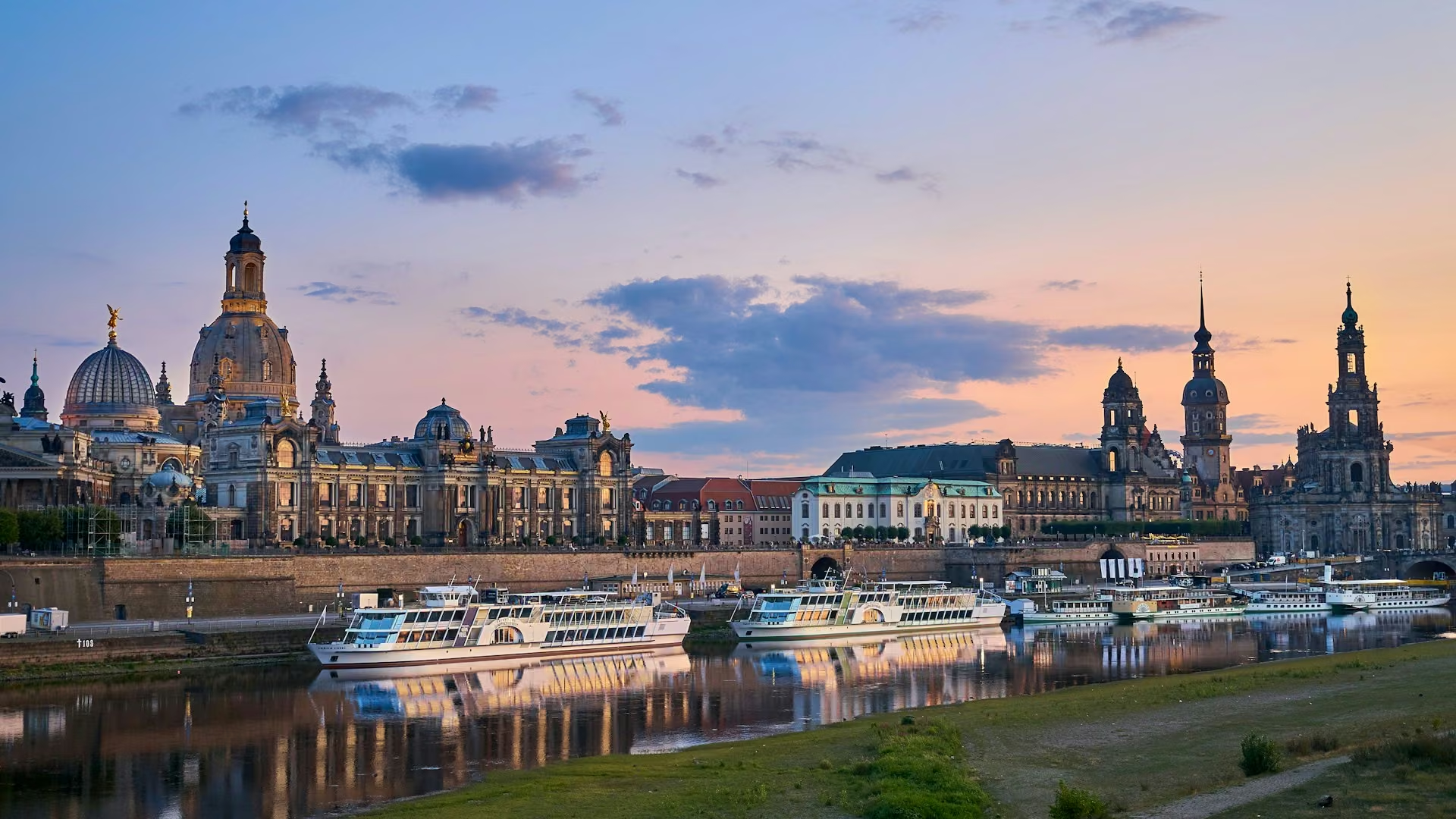
The Elbe sees far fewer river ships than the Rhine or Danube, and that is a large part of its appeal. This cruisetour starts with two days in Berlin, follows the river through Saxony and finishes with three days in Prague, so you get two great capitals and the small towns in between.
The route
Berlin · Potsdam · Wittenberg · Meissen · Dresden · Saxon Switzerland · Bad Schandau · Děčín · Prague
About the Elegant Elbe cruise
Elegant Elbe is a 10-day cruisetour that runs from Berlin to Prague, crossing from Germany into the Czech Republic. It opens with two full days in the German capital, then heads to Potsdam for Frederick the Great's summer palace before reaching Wittenberg, the town where Martin Luther set the Reformation in motion. From there the route follows the Elbe south through Saxony, a part of Germany many British travellers have never seen, and ends among the spires of Prague.
The middle of the trip is where the river comes into its own. Meissen has been making porcelain since the early 18th century and still marks every piece with crossed swords. Dresden, flattened by bombing in February 1945, has rebuilt its great baroque landmarks one by one. Then the valley narrows into Saxon Switzerland, a national park of sandstone towers, where the Bastei lookout gives one of the best river views in Germany. Long stretches of the Elbe further downstream, around Wittenberg and Dessau, are protected as a UNESCO biosphere reserve, and the river feels noticeably wilder than the busier ones.
You sail on one of Viking's purpose-built Elbe ships, Viking Astrild or Viking Beyla, which have custom hulls and engines for this shallow river while keeping the Longship style. Every stateroom faces the river. The fare covers return flights from London and selected regional airports, a shore excursion in each port of call, all meals on board, beer, wine and soft drinks with lunch and dinner, Wi-Fi, port taxes and onboard gratuities.
Prices start from £2,795 per person. We checked this in October 2026, and fares change with the departure date and the stateroom you choose, so drop us a line for current availability. This is a good pick if you already know the Rhine or Danube and want something less familiar, or if Berlin, Dresden and Prague have long been on your list and you would rather see them without driving or changing hotels.
For more on the river itself, see our The Elbe river cruise guide.
Cruise highlights
Berlin, twice over
Two days to see the Reichstag, the Brandenburg Gate and Checkpoint Charlie, then the newer cultural Berlin that grew up after reunification.
Sanssouci in Potsdam
Frederick the Great's rococo summer palace, built in the 1740s, sits above terraced vineyards. The king himself is buried on the terrace.
Luther's Wittenberg
Stand at the church where Luther posted his 95 Theses in 1517 and walk the streets of the town that launched the Reformation.
Meissen porcelain
Learn how Europe's first true hard-paste porcelain came to be made here, and why the crossed swords mark still matters to collectors.
Dresden reborn
The Zwinger, the Semper Opera House and the treasures of the Green Vault, in a city that rebuilt itself after 1945.
Saxon Switzerland and Prague
Sandstone pinnacles above the Elbe at the Bastei, then Prague's Old Town, Astronomical Clock, castle and Charles Bridge.
Watch the Elegant Elbe cruise
Video: Elegant Elbe (Viking Cruises)
Day by day itinerary
Arrive in Berlin
Your trip begins in the German capital, and the first day takes in the sights that defined Berlin's 20th century. The Reichstag, home of the German parliament, now wears Norman Foster's glass dome, finished in 1999 and open to visitors who book ahead. A short walk away is the Brandenburg Gate, completed in 1791 and for nearly three decades stranded beside the Wall. Then on to Checkpoint Charlie, the best known crossing between the American and Soviet sectors during the Cold War. Seeing these three together is the quickest way to understand how much this city has lived through, and how fast it has changed since 1989.
Berlin since reunification
Day two looks at the Berlin that emerged after Germany reunified in October 1990. Whole districts that sat in the shadow of the Wall have been rebuilt, and the cultural life of the city has grown with them. Museum Island, a UNESCO World Heritage Site on the Spree, holds five major museums, among them the Neues Museum, home of the bust of Nefertiti, and the Pergamon, which is closed for restoration until at least mid-2027. The East Side Gallery keeps a long stretch of the Wall covered in murals. Berlin is also a very good city for eating well on a modest budget, from currywurst at a street stand to the many cafés of Prenzlauer Berg.
Sanssouci, then Luther's town
This morning heads to Potsdam, once the summer seat of the Prussian kings. Sanssouci, whose French name means without worries, was built for Frederick the Great in the 1740s to designs by Georg Wenzeslaus von Knobelsdorff. It is a single-storey rococo palace set above stepped vineyard terraces, and the king asked to be buried beside it. His wish was finally granted in 1991, and visitors still leave potatoes on his grave in thanks for his promotion of the crop. Later you reach Wittenberg, where Luther is said to have posted his 95 Theses on the church door in 1517, an act that changed the course of European history.
Churches of the Reformation
A full day in Wittenberg, officially called Lutherstadt Wittenberg, gives time to see its churches properly. All Saints' Church, better known as the Castle Church, is where Luther and his colleague Philip Melanchthon are buried. Its original wooden doors were lost to fire, and bronze doors carrying the text of the theses were installed in the 19th century. St Mary's, the town church where Luther preached, holds an altarpiece by Lucas Cranach the Elder, who lived and worked in Wittenberg and served as its mayor. The Luther memorials here, together with those in nearby Eisleben, are listed by UNESCO. It is a small, walkable town and easy to enjoy at your own pace.
The home of European porcelain
Meissen is where Europe finally cracked the secret of hard-paste porcelain, long imported at great expense from China. Augustus the Strong, Elector of Saxony, set up the manufactory here in 1710 after the alchemist Johann Friedrich Böttger and his colleagues made the breakthrough. Today you learn how the pieces are shaped, painted and fired, and why such fine detail takes years of training. The crossed blue swords on the base have been the factory's mark for centuries. Above the old town, the Albrechtsburg castle and the Gothic cathedral share the hilltop, and the slopes around Meissen are planted with vines in one of Germany's smallest and most northerly wine regions.
Dresden, the Florence on the Elbe
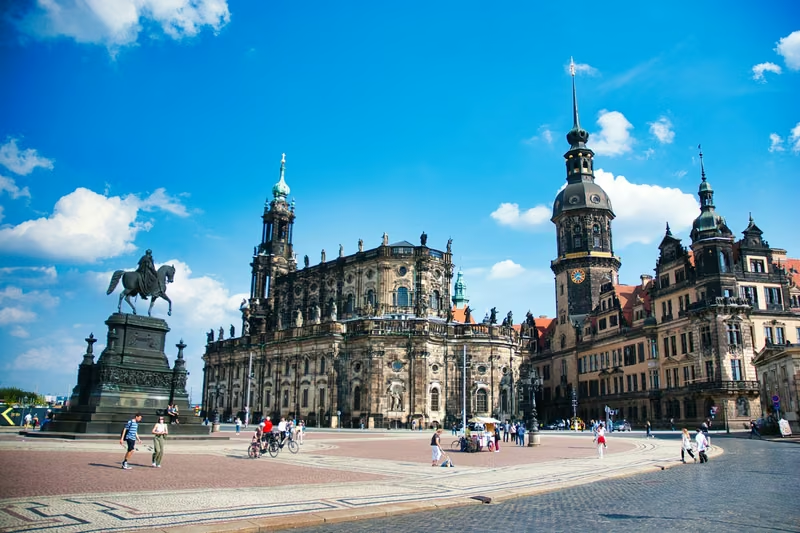
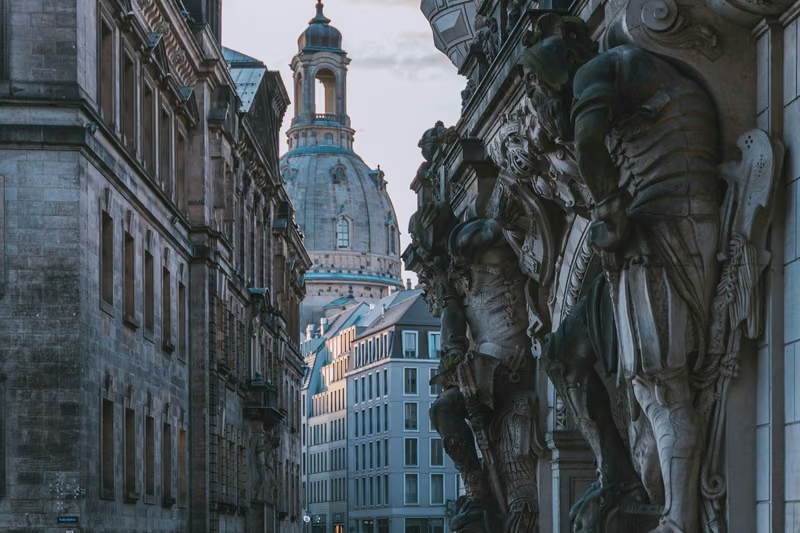
Dresden was once among the most beautiful cities in Europe, and the bombing raids of February 1945 left most of its centre in ruins. Its recovery has been remarkable. The Zwinger, an early 18th-century baroque complex, now houses the Old Masters Picture Gallery with Raphael's Sistine Madonna. The Semper Opera House, named after its architect Gottfried Semper, saw the premieres of several Richard Strauss operas. The Green Vault holds the dazzling treasure collection of the Saxon electors. Nearby, the Frauenkirche was rebuilt from its own rubble and reconsecrated in 2005. If you have a sweet tooth, look out for Dresden's famous Christmas stollen in the bakeries.
Sandstone towers above the river
Upstream from Dresden the Elbe cuts through a landscape of sandstone cliffs and pillars known as Saxon Switzerland. The name came from two Swiss artists working in Dresden in the 18th century, who said the scenery reminded them of home. Much of it is now a national park, and the scenic sailing gives you a fine view from the deck. From Bad Schandau you see the Bastei, a group of rock towers rising high above the river, linked by a sandstone bridge built in 1851. Painters of the Romantic era, Caspar David Friedrich among them, were drawn to these hills, and on a clear day it is easy to see why.
Into the Czech Republic
Over the border the river becomes the Labe, and the town of Děčín sits beneath its castle on the riverbank. Here you see the Děčín Synagogue, built in 1906 and 1907 in a striking Moorish style with art nouveau touches. It was one of very few synagogues in the former Sudetenland to survive the Second World War, having been used as a warehouse during the occupation. The day continues to Prague, which stands on the Vltava, a tributary of the Elbe. You learn about the city's long Jewish history, explore the Old Town and see the Astronomical Clock on the Old Town Hall, which dates from 1410 and still puts on its hourly show.
The City of a Hundred Spires
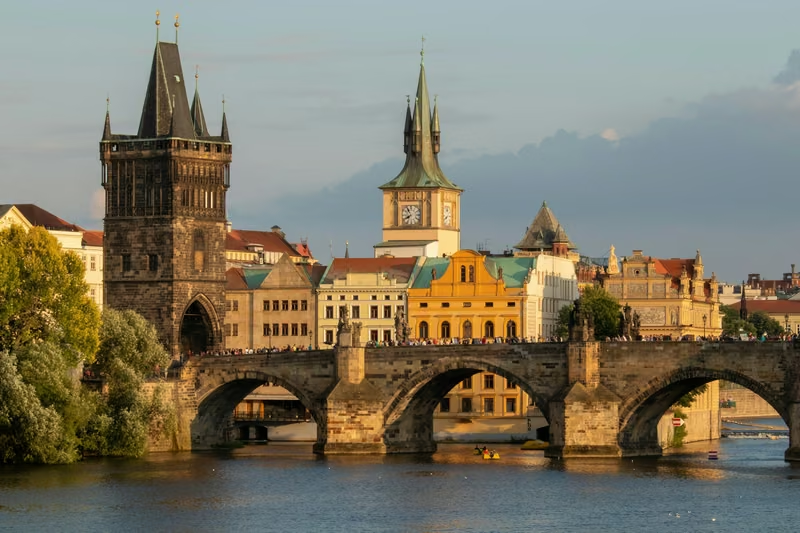
Today is about the grand sweep of Prague. Hradčany, the castle district, sits on the hill above the river and includes St Vitus Cathedral, the royal palace and the narrow Golden Lane. Below it, the Charles Bridge has crossed the Vltava since work began under Emperor Charles IV in 1357, and its parade of baroque statues was added later. The Malá Strana quarter between the castle and the bridge is full of baroque churches and palaces. Prague's musical connections run deep too, as Mozart premiered Don Giovanni at the Estates Theatre in 1787. Finish with a glass of Czech beer, which many visitors find hard to beat.
Farewell to Prague
Your cruisetour ends in Prague, and it is time to say goodbye to the friends you have made over the past ten days before your flight home. If you would like longer in the city, Viking offers a post-cruise Prague extension, and there is also a fully guided extension to Kraków and Warsaw for those who want to carry on into Poland. Prague rewards extra time, whether that means a morning in the Jewish Quarter around the Old-New Synagogue, a walk up Petřín Hill for the view, or simply an afternoon in a café on the Old Town Square watching the city go by.
Itineraries and shore excursions are set by Viking and can change, and may vary by departure.
The places you will visit
Luther, Wittenberg and the Reformation
In 1517 Wittenberg was a modest university town on the Elbe. Martin Luther, an Augustinian friar who taught theology there, objected to the sale of indulgences and set out his arguments in 95 Theses. Tradition holds that he nailed them to the door of the Castle Church on 31 October, which was where university notices were posted. Thanks to the printing press, copies spread across Germany within weeks. What began as an academic dispute grew into the Protestant Reformation, splitting Western Christianity and reshaping politics across Europe for centuries.
Luther stayed in Wittenberg for most of his life. He lived in the former Augustinian monastery with his wife Katharina von Bora, and the house is now the Luther House museum, one of the largest museums of Reformation history. His friend Lucas Cranach the Elder ran a busy workshop in town and painted the portraits of Luther that most of us picture today. When Luther died in 1546 in Eisleben, his body was brought back and buried in the Castle Church. Walking between these sites, you get a real sense of how small the stage was for such a large story.
Dresden and the Saxon court
Dresden's splendour owes a great deal to Augustus the Strong, Elector of Saxony and King of Poland, who ruled in the late 17th and early 18th centuries. He spent lavishly on buildings, art and jewels. The Zwinger was built for court festivities, designed by Matthäus Daniel Pöppelmann, and the Green Vault was created to display the electors' treasures. Augustus also founded the Meissen porcelain works and collected Asian porcelain on a vast scale. Under his successors, the city's riverfront became so admired that it earned the nickname Florence on the Elbe.
The raids of 13 to 15 February 1945 destroyed much of the old city and killed many thousands of people. In the decades of East German rule, some landmarks were restored while others, like the Frauenkirche, were left as ruins and became a memorial. After reunification, the church was rebuilt using as many of its original stones as could be identified, with funds raised around the world. A new golden orb and cross for the dome was made in Britain, a gesture of reconciliation. Its consecration in 2005 drew huge crowds and remains a powerful moment in the city's recent history.
Prague, from Charles IV to Kafka
Prague's golden age came under Charles IV, King of Bohemia and Holy Roman Emperor in the 14th century. He founded Charles University in 1348, laid out the New Town and began both the stone bridge that now carries his name and the Gothic St Vitus Cathedral. The Old Town's Astronomical Clock followed in 1410. Prague survived the 20th century largely intact, which is why its skyline of towers and domes looks so complete today and why the historic centre is listed as a UNESCO World Heritage Site.
The city's Jewish history is one of the longest in Europe. In the Josefov quarter, the Old-New Synagogue dates from the 13th century and is still in use, and the Old Jewish Cemetery is layered with thousands of crowded gravestones. Franz Kafka was born nearby in 1883 and spent most of his life in Prague, and you can find his traces all over the Old Town. Music runs through the city too, from Mozart's Don Giovanni to Dvořák and Smetana, whose cycle Má vlast includes the much loved portrait of the Vltava.
What is included
Viking prices its river cruises to include most of what you need, so there are few extras to budget for once you are on board.
Return flights
Return flights from London and selected regional airports, with ground transfers included when you fly with Viking.
A shore excursion in every port
One included shore excursion in each port of call, usually a guided walking or coach tour, with optional extras to buy.
All meals on board
Breakfast, lunch and dinner every day you are on board, including al fresco dining on the Aquavit Terrace.
Drinks with lunch and dinner
Beer, wine and soft drinks served with lunch and dinner, plus specialty coffee, tea and bottled water at any hour.
Free Wi-Fi
Wi-Fi is included on board at no extra charge, though speeds can vary as the ship moves along the river.
Port taxes and fees
Port taxes and fees are built into the fare, so there are no extra charges waiting at the end.
Onboard gratuities
Gratuities for the crew on board are included in the fare.
Enrichment and performances
Talks on the history and culture of your route, plus local performers who bring the destinations to life on board.
Your stateroom, the ship and its facilities are covered on our Viking Longships page.
Fares
| Cruise | Duration | From, per person |
|---|---|---|
| Elegant Elbe, Berlin to Prague | 10 days | £2,795 |
Lead-in fare per person, checked in October 2026. Viking's fares change with the date, direction of sailing and stateroom grade, so please email us for live prices and availability on the departure you have in mind.
Interested in the Elegant Elbe? Email us your preferred month and we will send dates and prices.
Email an enquiry- Best time to go is late spring to early autumn. River levels on the Elbe can fall in very dry summers, which occasionally means itinerary changes, so it is worth asking us about this when you book.
- Berlin and Prague are both big cities with plenty to see. Viking offers a pre-cruise Berlin extension and post-cruise Prague and Kraków and Warsaw extensions if you would like more time.
- The pace is gentle, with plenty of walking on cobbles in old towns and some steps at Sanssouci and the Bastei. Comfortable shoes are a must.
- It suits travellers interested in history, art and music, and those who have already done a Rhine or Danube cruise and want a quieter river.
- Prague sits on the Vltava rather than the Elbe, so the final part of the journey into the city is by road.
Elegant Elbe: your questions answered
The fare includes return flights from London and selected regional airports, one shore excursion in every port of call, all meals on board, beer, wine and soft drinks with lunch and dinner, specialty coffee, tea and bottled water at any hour, free Wi-Fi, port taxes and fees, enrichment talks and onboard gratuities. Ground transfers are included when you book Viking's flights.
Viking uses its purpose-built Elbe ships, Viking Astrild and Viking Beyla. They share the clean Scandinavian design of the Viking Longships but have customised hulls and engines to handle the shallower Elbe. Every stateroom has a river view, and the smaller size of these ships suits the quiet, intimate character of the river and its towns.
Prices start from £2,795 per person. We checked this in October 2026, and fares vary by departure date and stateroom category. Email us at enquiries@rivercruiseworld.co.uk and we will check live availability and prices for the dates you have in mind.
Spring through to early autumn is the main season. May, June and September tend to be pleasant for walking around towns and cities without the peak summer heat. The Elbe can run low in long dry spells, so a little flexibility helps, and we can talk you through what Viking does if levels change.
You need to be comfortable walking for an hour or two at a time, often on cobbled streets. Sanssouci has terraces and steps, and the Bastei involves some walking on paths and uneven ground. If you have mobility concerns, ask us before booking and we can look at the details of each day with you.
Yes. Viking offers a pre-cruise extension in Berlin and post-cruise extensions in Prague, plus a fully guided extension to Kraków and Warsaw. These are a good way to see more of the two capitals or carry on into Poland. Extensions vary by itinerary and can change, so ask us for the current options.
The route runs from Berlin to Potsdam and Wittenberg, then Meissen, Dresden, a scenic sailing through Saxon Switzerland with a stop at Bad Schandau, Děčín just over the Czech border, and finally Prague. That gives you two capital cities, a royal palace, the birthplace of the Reformation and some of Germany's finest river scenery.
You might also like
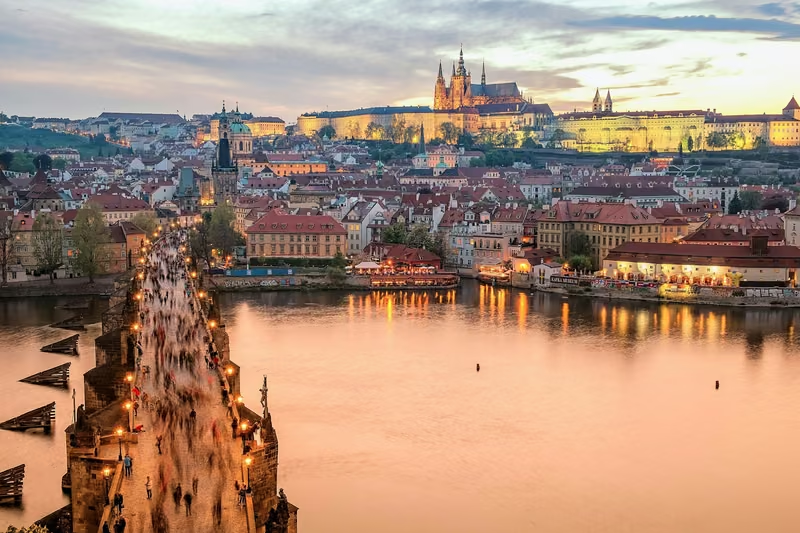
Cities of Light
Twelve days from Paris to Prague, following the Moselle, Rhine and Main through Roman Trier, wine country and the old towns of Franconia.
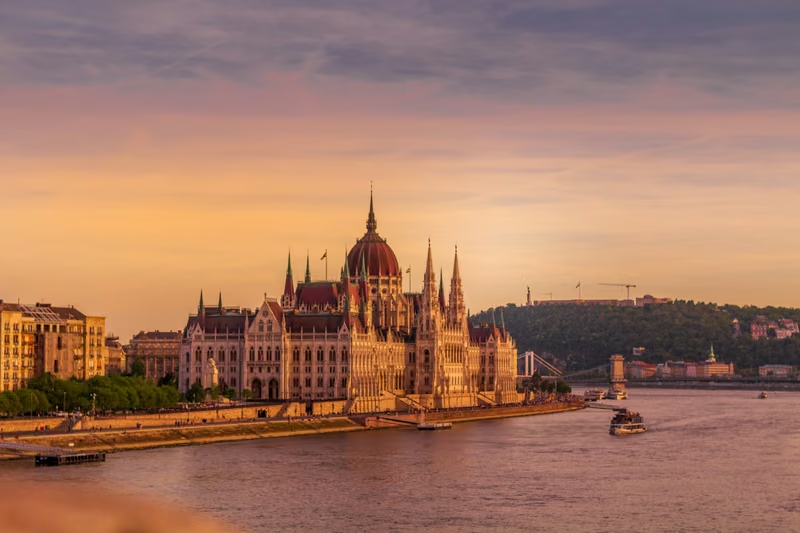
Romantic Danube
Eight days on the Danube from Budapest to medieval Regensburg, with two full days in Vienna and a slow sail through the vineyards of the Wachau.
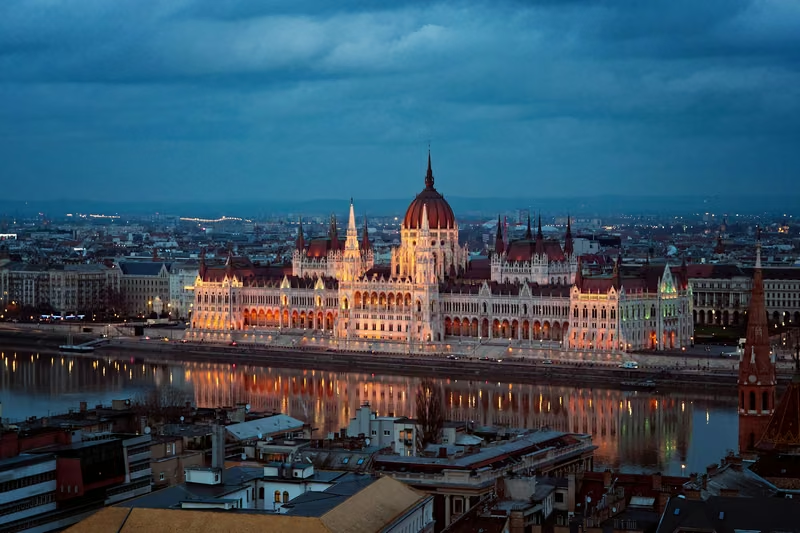
Danube Waltz
A week on the Danube from Budapest to Passau, taking in four countries, two capitals that rarely get the attention they deserve and the vineyards of the Wachau.