This new Viking itinerary is a proper crossing of the continent. You start beside the thermal baths of Budapest, follow the Danube west through Austria and Bavaria, climb over the European watershed on the Main-Danube Canal, and finish beside the Rhine in Switzerland.
The route
Budapest · Vienna · Krems · Passau · Regensburg · Nuremberg · Bamberg · Würzburg · Marktheidenfeld · Frankfurt · Baden-Baden · Strasbourg · Breisach · Basel
About the Rhine, Main & Danube Odyssey cruise
The first part of the cruise follows the Danube upstream. Budapest has two days, enough time to see both Buda's castle hill and the grand avenues of Pest, before the ship sails through the Danube Bend towards Austria. Vienna also gets two days, so you can enjoy a concert or a long afternoon in a coffee house. Then comes the Wachau Valley, with its apricot orchards and terraced vineyards, and a visit to the hilltop abbey of Göttweig.
From Passau the route turns into Bavaria. Regensburg, Nuremberg and Bamberg are three of the best preserved historic cities in Germany, and each has its own character. Regensburg is medieval and lively, Nuremberg carries the weight of both its imperial past and the 20th century, and Bamberg is famous for smoked beer. Between them the ship uses the Main-Danube Canal, which crosses the high ground separating the Danube's basin from the Rhine's.
The Main brings you to Würzburg and its baroque Residenz, then through the wooded Spessart hills of Franconia, with a stop in the small town of Marktheidenfeld for some hearty regional cooking. Frankfurt is next, Germany's financial centre, with a skyline of towers and a surprisingly pretty old town. Back on the Rhine you visit the elegant spa town of Baden-Baden, then Strasbourg, with its pink cathedral and Alsatian food, and Breisach for the Black Forest, before two final days in Basel, often called Switzerland's cultural capital.
It is a long trip, and it suits travellers with time to spare who like the idea of a slow, continuous journey rather than a series of hops. You keep the same stateroom all the way, which makes eighteen days feel surprisingly restful. Each region has its own character, and you notice the food, wine and architecture changing gradually as you cross five countries, from Hungarian paprika and Viennese pastries to Franconian sausages and Alsatian tarte flambée. Few river cruises give such a clear sense of how Europe fits together.
For more on the river itself, see our The Danube river cruise guide, The Main and Moselle river cruise guide, The Rhine river cruise guide.
Cruise highlights
Budapest's two halves
Explore Buda's Castle District and the grand boulevards of Pest, with time to try one of the city's famous thermal baths.
Vienna over two days
Enjoy the imperial architecture and musical heritage of the Austrian capital, and allow time for a slice of cake in a traditional café.
Göttweig Abbey and the Wachau
Visit a Benedictine abbey with a grand frescoed staircase, then sail through the UNESCO-listed Wachau Valley.
Three great Bavarian cities
See medieval Regensburg, historic Nuremberg and Bamberg, whose old town is UNESCO-listed and whose beer is smoked.
The Würzburg Residenz
Tour one of Europe's finest baroque palaces, famous for its staircase and its enormous ceiling fresco by Tiepolo.
Baden-Baden and Strasbourg
See the elegant Kurhaus of Germany's best known spa town, then enjoy Alsatian food beneath Strasbourg's soaring cathedral.
Day by day itinerary
Welcome to Budapest
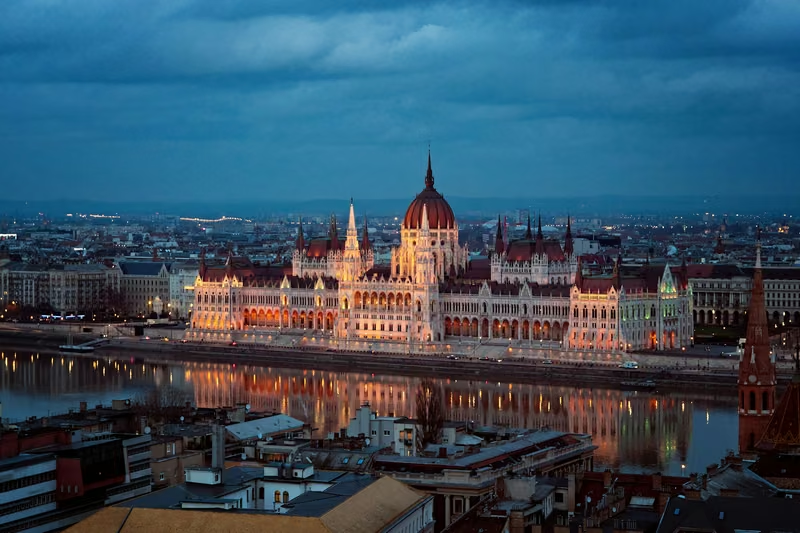
Your journey begins in Budapest, a city split by the Danube into two very different halves. On the west bank, hilly Buda is crowned by the Castle District, with its royal palace, the Matthias Church and the white turrets of Fishermen's Bastion. Across the river, flat Pest is the busier, more modern side, home to the huge neo-Gothic Parliament building, broad avenues and lively cafés. The two towns, together with Óbuda, were only united as one city in 1873. Seen from the ship, especially at night when the bridges and Parliament are lit up, the riverfront is spectacular.
A day of choices and the Danube Bend
Spend the morning however suits you best. Walk across the Chain Bridge, the first permanent bridge to link Buda and Pest, opened in 1849 and designed by the English engineer William Tierney Clark. You could visit one of the city's museums, or relax in a thermal spa such as the Széchenyi or Gellért baths, part of a bathing tradition going back to the Romans and Ottomans. Later the ship sets off upstream through the Danube Bend, where the river turns sharply between wooded hills. Look out for the castle ruins at Visegrád and the great domed basilica at Esztergom as you sail past.
Imperial Vienna
Vienna was the capital of the Habsburg empire for centuries, and its architecture still reflects that grandeur. A tour takes you around the Ringstrasse, the broad boulevard built in the 19th century on the line of the old city walls, past the State Opera, the Hofburg palace and the parliament. In the centre, St Stephen's Cathedral rises above the old town with its colourful tiled roof. This was also the city of Mozart, Haydn, Beethoven, Schubert and the Strauss family, and music is everywhere, from concert halls to buskers on the shopping streets. An evening concert is a lovely way to end the day.
Museums, palaces and pastries
A second day in Vienna gives you time to explore at your own pace. The city has superb museums, including the Kunsthistorisches Museum with its great collection of old masters, and the Belvedere, where you can see Klimt's The Kiss. Schönbrunn, the Habsburgs' summer palace, lies a short trip from the centre. Whatever you choose, do not miss the coffee houses. Viennese coffee house culture is listed as part of Austria's intangible cultural heritage, and the ritual of coffee, cake and a newspaper is part of daily life. Sachertorte and apple strudel are the classics to try.
Göttweig Abbey and the Wachau Valley
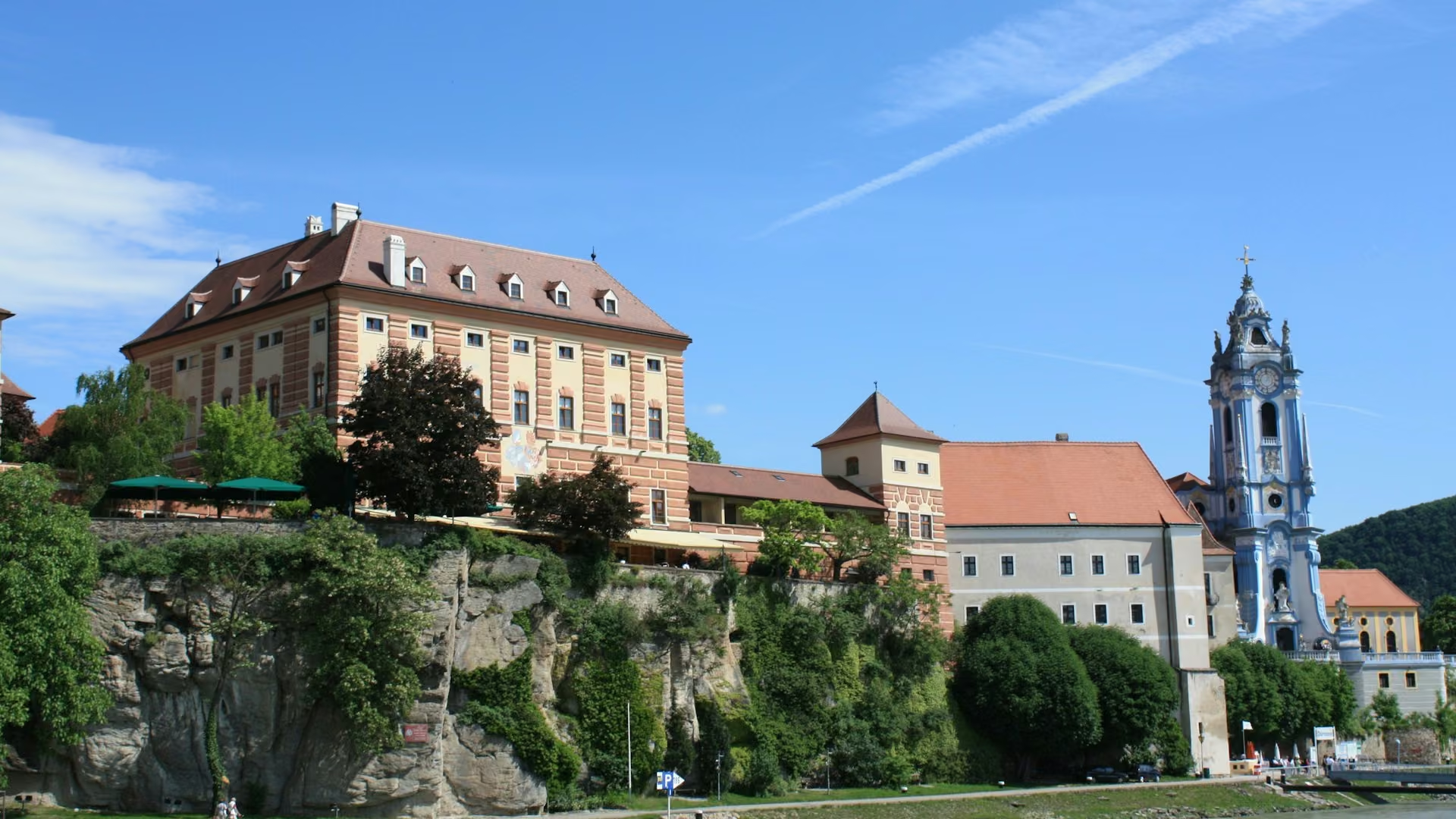
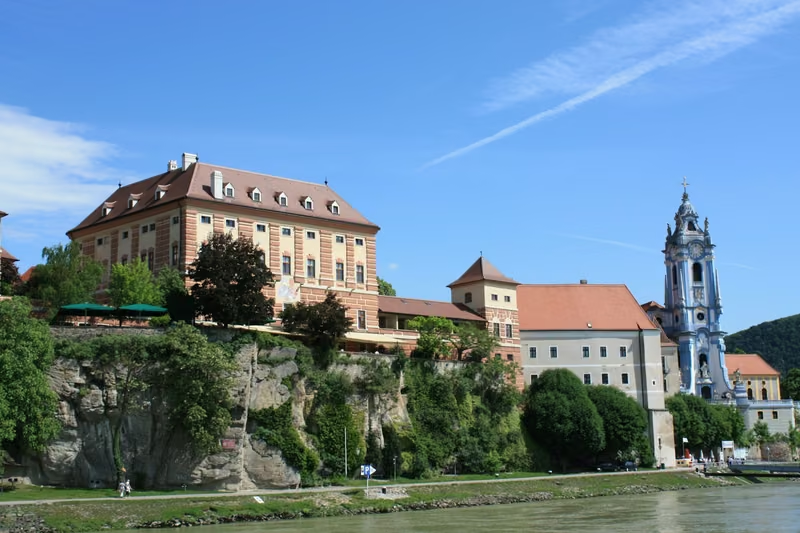
From Krems you visit Göttweig Abbey, a Benedictine monastery founded in 1083 and set on a hilltop above the Danube. Rebuilt in baroque style after a fire in 1718, it is known for its Imperial Staircase, with a ceiling fresco painted by Paul Troger in 1739. You will also see the library and the abbey church. Later the ship sails through the Wachau Valley, a UNESCO-listed stretch of the Danube lined with vineyards, apricot orchards and small towns. Watch for the ruined castle above Dürnstein, where Richard the Lionheart was held prisoner on his way home from the Crusades.
Passau, city of three rivers
Passau sits on a narrow peninsula where three rivers meet: the Danube, the Inn and the small Ilz. Each has a slightly different colour, which you can sometimes see where they join. After fires in the 17th century, the town was largely rebuilt in baroque style by Italian architects, and its old town is full of elegant patrician houses and arcaded lanes. The highlight is St Stephen's Cathedral, richly decorated inside with white stucco and frescoes, and home to one of the largest church organs in the world. If you are lucky, you may catch one of the regular organ recitals.
Medieval Regensburg
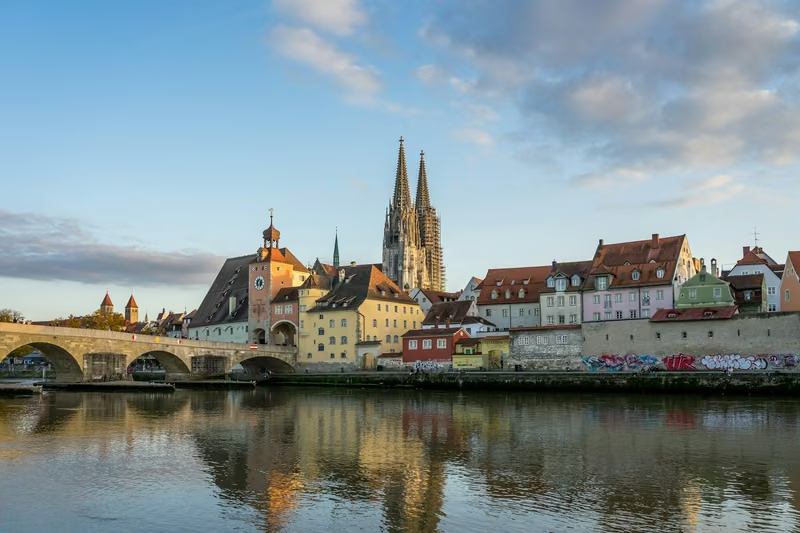
Regensburg is one of the best preserved medieval cities in Germany, and its old town is UNESCO-listed. It began as a Roman fort in the 2nd century and later became a wealthy trading centre, with merchant families building tall tower houses to show off their wealth. A walk through its narrow streets takes you past the Gothic cathedral of St Peter, the old town hall where the Imperial Diet once met, and the 12th-century Stone Bridge across the Danube. It is a lively university city too, with plenty of beer gardens and cafés along the river.
Regensburg's landmarks and on to Nuremberg
There is more time in Regensburg this morning to enjoy its architectural highlights. Near the Stone Bridge you can visit the Historische Wurstküche, a small sausage kitchen that has been serving travellers for centuries and is often described as the world's first fast-food restaurant. Later the ship moves on to Nuremberg, where you see the Palace of Justice, scene of the war crimes trials after the Second World War. In the old town, the Market Square is home to the Gothic Schöner Brunnen fountain and the Church of Our Lady. Try the small Nuremberg sausages, grilled over beech wood.
Nuremberg through the centuries
Today you dig deeper into Nuremberg's history. In the Middle Ages it was one of the most important cities of the Holy Roman Empire, and the imperial castle on its sandstone hill was a favourite residence of the emperors. The artist Albrecht Dürer lived and worked here, and his house is now a museum. The 20th century brought darker chapters, as the Nazi party held its rallies on the edge of the city, and much of the old centre was destroyed by bombing in 1945. Today Nuremberg has been carefully rebuilt, and its story is told with great honesty.
Bamberg and its smoked beer
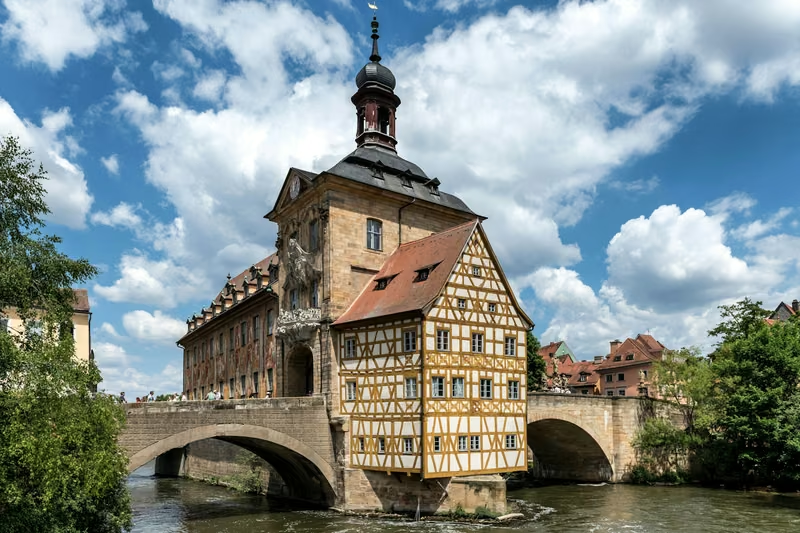
Bamberg is one of Germany's loveliest towns, built on seven hills like Rome and largely untouched by wartime bombing. Its old town is UNESCO-listed. The Old Town Hall is its best known sight, perched on an island in the middle of the Regnitz river and painted with colourful frescoes. The cathedral contains the tomb of Emperor Henry II and his wife Kunigunde, and the famous statue known as the Bamberg Horseman. Bamberg is also a beer town, and its speciality is rauchbier, made with malt dried over a wood fire, which gives it a distinctive smoky taste.
The Residenz at Würzburg
Würzburg is surrounded by vineyards and is the centre of the Franconian wine region. Its main sight is the Residenz, the palace built for the prince-bishops in the 18th century and designed by Balthasar Neumann. It is one of the finest baroque palaces in Europe and is UNESCO-listed. The grand staircase is covered by a vast ceiling fresco by the Venetian painter Giovanni Battista Tiepolo, showing the four continents then known to Europeans. Afterwards, wander down to the Old Main Bridge, lined with statues of saints, and try a glass of local Silvaner wine.
Franconian flavours and the Spessart
Marktheidenfeld is a small town on the Main, and a good place to get to know the food and traditions of the region. Expect hearty Franconian and Bavarian dishes, such as roast pork, dumplings and sausages, along with a glass of local wine or beer. Later the ship continues along the Main through the Spessart, a range of low hills covered in forest. The river winds between wooded slopes and small villages, with red sandstone churches and half-timbered houses along the banks. It is a peaceful day of cruising, ideal for relaxing on deck.
Frankfurt on the Main
Frankfurt is Germany's financial capital, home to the European Central Bank and a skyline of glass towers. Yet it also has a charming historic heart. The Römerberg square, with its stepped gables and the old town hall, was rebuilt after the war, and recent years have seen the reconstruction of more of the old town around it. You can take a walk along the riverside path by the Main, or visit the house where the writer Goethe was born in 1749. In the Sachsenhausen district across the river, traditional taverns serve the local apple wine with green sauce.
The spa town of Baden-Baden
Baden-Baden lies at the edge of the Black Forest and has been famous for its hot springs since Roman times. In the 19th century it became one of the most fashionable resorts in Europe, attracting royalty, writers and composers. Its centrepiece is the Kurhaus, an elegant neoclassical building that houses the casino, where the Russian novelist Dostoevsky famously lost money. The town's thermal baths range from the historic Friedrichsbad to the modern Caracalla spa. Take a stroll along the Lichtentaler Allee, a park beside the river, and admire the villas of the town.
Strasbourg and Alsatian cooking
Strasbourg has belonged to both France and Germany over the centuries, and the two cultures blend here in its food, architecture and language. Its Gothic cathedral, built from pink sandstone, was for more than two centuries the tallest building in the world, and its astronomical clock is a popular attraction. The UNESCO-listed old town on the Grande Île includes Petite France, a quarter of canals and half-timbered houses. Alsatian cooking is generous and hearty, so try tarte flambée, choucroute or a slice of kugelhopf, with a glass of local Riesling or Gewurztraminer.
Breisach and the Black Forest
Breisach sits on the German bank of the Rhine, a small town topped by its hilltop Minster of St Stephan. It is the gateway to the Black Forest, the region of dense conifer forests, rolling hills and traditional farmhouses that gave the world cuckoo clocks and Black Forest gateau. The scenery is beautiful in every season, with green meadows and small villages tucked into the valleys. Expect a day of open landscapes and fresh air. In the evening, enjoy your last nights on board as the ship heads for Switzerland.
Discover Basel
Basel stands on a bend of the Rhine where Switzerland, France and Germany meet, and it is often thought of as Switzerland's cultural capital. The old town has a red sandstone cathedral, where the scholar Erasmus is buried, and a colourful town hall painted with frescoes. The city has more than its share of museums, including the Kunstmuseum, one of the oldest public art collections in the world, and the Fondation Beyeler just outside the centre. Basel also hosts Art Basel, one of the world's leading art fairs. Take a small ferry across the Rhine, pulled along by the current.
Farewell in Basel
Your cruise ends in Basel, where you say goodbye to your fellow guests and fly home, or stay on to see more of Switzerland. If you have extra time, Basel is a pleasant city to explore on foot, with easy access to the rest of the country by train. Viking offers a two-night post-cruise extension in Lucerne, a lovely lakeside city surrounded by mountains, and a four-night fully guided tour of the Swiss Alps with a scenic train journey. Before the cruise, you can also add two nights in Budapest or a four-night tour of Croatia and Slovenia.
Itineraries and shore excursions are set by Viking and can change, and may vary by departure.
The places you will visit
Vienna, the Wachau and the Danube story
For over six centuries the Habsburgs ruled from Vienna, and their empire at its height stretched across much of central and eastern Europe. The city they left behind is full of palaces, museums and theatres, and the Ringstrasse, built after the old walls came down in the 1850s, is lined with grand public buildings. Music became part of the city's identity. Mozart wrote his greatest operas here, Beethoven spent most of his working life in Vienna, and Johann Strauss II gave the world the Blue Danube waltz. Concerts are still a big part of daily life.
Upstream from Vienna, the Wachau Valley is one of the most beautiful stretches of the river. It was listed by UNESCO in 2000 as a cultural landscape shaped over centuries by monasteries, castles and vineyards. The terraced slopes produce excellent Grüner Veltliner and Riesling, and the valley's apricots, known locally as Marillen, are used in jams, brandies and dumplings. Göttweig Abbey watches over the valley's eastern entrance, and Melk Abbey stands at the western end. The castle at Dürnstein, where Richard the Lionheart was held in 1192 and 1193, gives the valley one of its most famous stories.
Crossing Europe on the Main-Danube Canal
For centuries people dreamed of linking the Danube, which flows to the Black Sea, with the Rhine, which flows to the North Sea. Charlemagne tried to build a canal in the 8th century, and in the 19th century King Ludwig I of Bavaria built a smaller one that soon became outdated. The modern Main-Danube Canal was completed in 1992. It runs for 171 kilometres from Kelheim on the Danube to Bamberg on the Main, rising to 406 metres above sea level at its highest point, and it makes a river journey across the whole of Europe possible.
The canal passes close to Nuremberg, which was one of the great cities of the Holy Roman Empire and a centre of crafts, trade and printing. Albrecht Dürer, the greatest German artist of the Renaissance, was born here in 1471. In the 20th century the city was chosen by the Nazis for their party rallies, and after the war it was the setting for the trials of Nazi leaders in the Palace of Justice. The courtroom where the trials were held is part of a memorial and museum that explains this history clearly.
Franconia, Frankfurt and the spa town of Baden-Baden
Franconia, in the north of Bavaria, has a character all its own. Its wines are bottled in the distinctive flat, round Bocksbeutel, and Silvaner is the classic grape. Bamberg, one of the region's jewels, is home to the tomb of Pope Clement II, the only papal burial in Germany. Würzburg's prince-bishops, meanwhile, spent lavishly on art and architecture, and the Residenz, finished in the 18th century, shows their ambition. The staircase and its fresco came through the bombing of 1945, although much of the palace and the city around it were badly damaged. Tiepolo's ceiling fresco over the staircase is one of the largest ever painted.
Further west, Frankfurt was where German emperors were elected and later crowned, and in 1848 the city's Paulskirche hosted Germany's first freely elected parliament. Goethe, the country's most celebrated writer, was born here. Baden-Baden has a very different story. Its hot springs drew the Romans, and in the 19th century it became the summer meeting place of European high society. Writers such as Dostoevsky and Turgenev stayed here, and Brahms spent summers in the area. The town has kept its elegant atmosphere, with villas, gardens and spa buildings from that era.
What is included
Viking prices its river cruises to include most of what you need, so there are few extras to budget for once you are on board.
Return flights
Return flights from London and selected regional airports, with ground transfers included when you fly with Viking.
A shore excursion in every port
One included shore excursion in each port of call, usually a guided walking or coach tour, with optional extras to buy.
All meals on board
Breakfast, lunch and dinner every day you are on board, including al fresco dining on the Aquavit Terrace.
Drinks with lunch and dinner
Beer, wine and soft drinks served with lunch and dinner, plus specialty coffee, tea and bottled water at any hour.
Free Wi-Fi
Wi-Fi is included on board at no extra charge, though speeds can vary as the ship moves along the river.
Port taxes and fees
Port taxes and fees are built into the fare, so there are no extra charges waiting at the end.
Onboard gratuities
Gratuities for the crew on board are included in the fare.
Enrichment and performances
Talks on the history and culture of your route, plus local performers who bring the destinations to life on board.
Your stateroom, the ship and its facilities are covered on our Viking Longships page.
Fares
| Cruise | Duration | From, per person |
|---|---|---|
| Rhine, Main & Danube Odyssey, Budapest to Basel | 18 days | £4,790 |
Lead-in fare per person, checked in October 2026. Viking's fares change with the date, direction of sailing and stateroom grade, so please email us for live prices and availability on the departure you have in mind.
Interested in the Rhine, Main & Danube Odyssey? Email us your preferred month and we will send dates and prices.
Email an enquiry- Spring and early autumn are ideal for this route, with comfortable temperatures and, in autumn, the grape harvest in the Wachau and Franconia.
- Arrive in Budapest a day or two early if you can, as the city is well worth extra time; Viking offers pre-cruise extensions there.
- This is a long journey with many walking tours, so pace yourself and use the quieter cruising days to rest.
- The ship passes through many locks on the Main and the canal, which is part of the fun but can mean some night-time movement.
- The route suits travellers who want to see a wide variety of Europe in one trip without changing hotels.
Rhine, Main & Danube Odyssey: your questions answered
Viking's fare includes return flights from London and selected regional airports, one included shore excursion in every port of call, all onboard meals, beer, wine and soft drinks with lunch and dinner, 24-hour specialty coffee, tea and bottled water, free Wi-Fi, port taxes and fees, enrichment lectures and onboard gratuities. Ground transfers are included with Viking flights. Prices start from £4,790 per person, checked in October 2026, and vary with date and stateroom.
The cruise uses one of Viking's European Longships, designed to fit the locks and bridges of the Danube, Main and Rhine. Every stateroom has a river view, a Viking Explorer bed and a heated bathroom floor. Because the ship can sail the whole route, you unpack once and keep the same stateroom for all 18 days.
Late spring and early autumn are the most comfortable times, with mild weather for walking tours. Summer brings long days and outdoor life in the beer gardens, but can be warm in the cities. Autumn departures coincide with the grape harvest in the Wachau and Franconia, which adds a lovely seasonal feel to the vineyard regions.
Most days include walking tours of an hour or two, often on cobbled streets. Some sites, such as Göttweig Abbey, the Würzburg Residenz and Nuremberg's castle area, involve steps or gentle hills. With 18 days on the move, it helps to be reasonably active, but there are quieter days and you can skip a tour if you need a rest.
Viking includes return flights from London and selected regional airports. You fly out to Budapest at the start and home from Basel at the end. Basel's airport serves both Switzerland and France, so it is easy to reach. We can tell you which regional airports are available for your chosen departure.
Yes. Before the cruise you can choose two nights in Budapest, including a premium version, or a four-night fully guided tour of Croatia and Slovenia. Afterwards there is a two-night stay in Lucerne or a four-night fully guided Swiss Alps tour with a scenic train ride. Extensions vary and are subject to change, so ask us for the latest prices.
You visit Budapest, Vienna, Krems, Passau, Regensburg, Nuremberg, Bamberg, Würzburg, Marktheidenfeld, Frankfurt, Baden-Baden, Strasbourg, Breisach and Basel. That takes in Hungary, Austria, Germany, France and Switzerland, with scenic sailing through the Danube Bend, the Wachau Valley and the Spessart hills along the way.
You might also like
Grand European Tour
Fifteen days across the continent by water, from the bridges of Budapest to the canals of Amsterdam, linking the Danube, the Main and the Rhine.
Danube Waltz
A week on the Danube from Budapest to Passau, taking in four countries, two capitals that rarely get the attention they deserve and the vineyards of the Wachau.
Rhine & Main Explorer
Eleven days from Nuremberg to Basel, through the wine towns of Franconia and down the Rhine to Alsace and the Swiss border.