The Rhine has carried traders, pilgrims and armies for two thousand years, and it still makes the most natural introduction to river cruising. This week-long sailing follows it downstream through four countries, so most mornings bring a new town and a different accent on the quayside.
The route
Basel · Breisach · Strasbourg · Speyer · Rüdesheim · Middle Rhine · Koblenz · Cologne · Kinderdijk · Amsterdam
About the Rhine Getaway cruise
Viking's Rhine Getaway starts in Basel, where Switzerland, France and Germany meet, and finishes eight days later in Amsterdam. In between you follow the river north across the Upper Rhine plain, through the narrow gorge of the Middle Rhine and out over the flat Dutch delta. It is a route with real variety. One day you are eating tarte flambée in Strasbourg, the next you are tasting Riesling in Rüdesheim, and before the week is out you are standing beneath the twin spires of Cologne Cathedral.
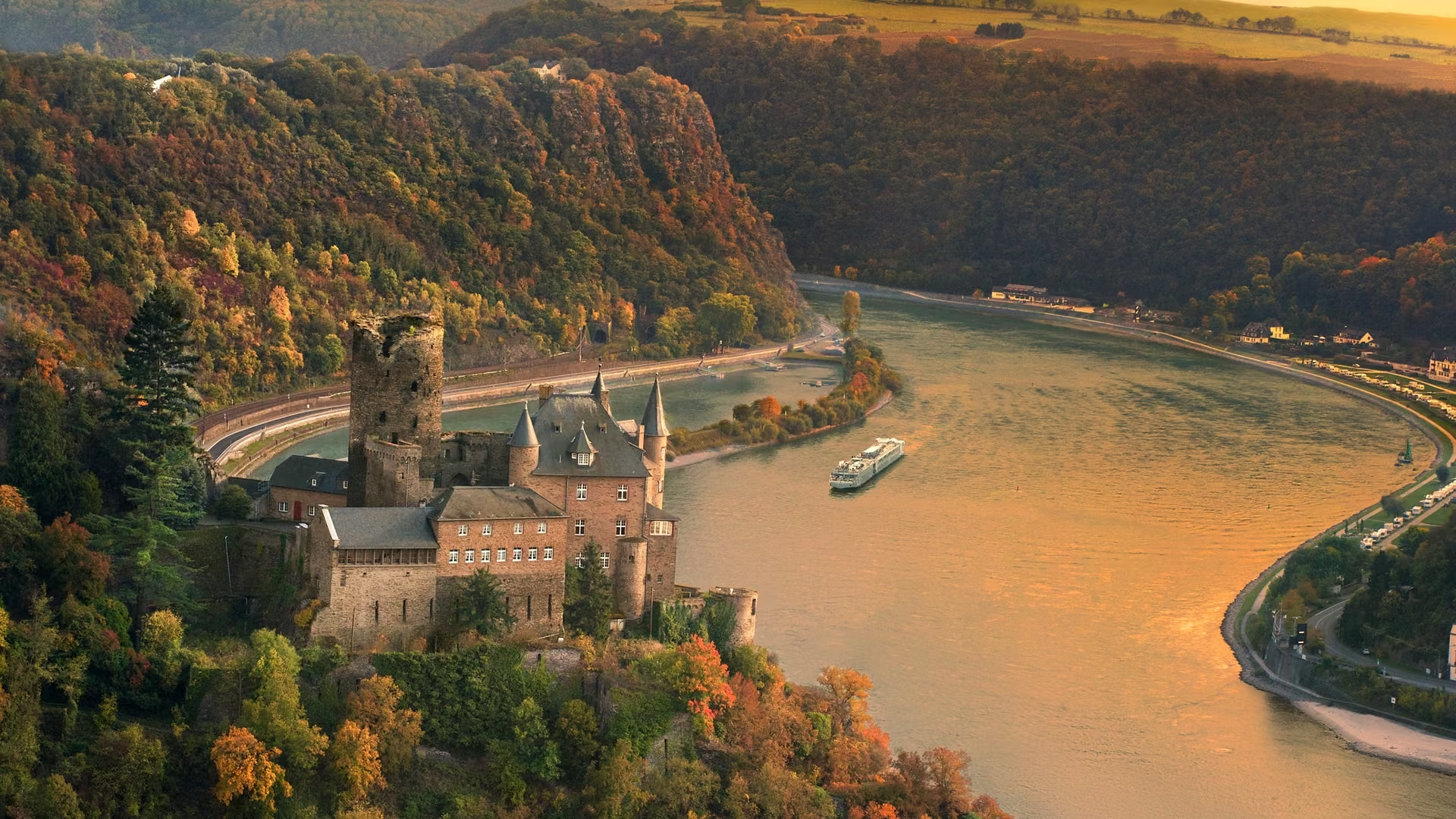
The scenery changes as much as the food. Around Breisach the Black Forest rises to the east while the Vosges line the French side. Between Bingen and Koblenz the valley tightens, the slopes steepen with vineyards and another castle seems to appear round every bend. This stretch, the Upper Middle Rhine Valley, has been a UNESCO World Heritage Site since 2002, and the ship takes its time sailing through it, passing the famous Lorelei rock on the way to Koblenz.
Your ship is a Viking Longship carrying 190 guests, with river view staterooms throughout. A guided shore excursion is included in every port, along with all meals on board, beer, wine and soft drinks with lunch and dinner, Wi-Fi, port taxes and onboard gratuities. Return flights from London and selected UK regional airports are part of the package, and transfers are included when you book Viking's flights. Fares start from £1,695 per person. We checked prices in October 2026, and they vary with departure date and stateroom.
For more on the river itself, see our The Rhine river cruise guide, Holland and Belgium river cruise guide.
Cruise highlights
Strasbourg Cathedral
A Gothic church of pink Vosges sandstone whose spire was the tallest in the world for over two centuries. The half-timbered lanes of La Petite France are a short walk away.
Speyer's imperial cathedral
The largest Romanesque church still standing, consecrated in 1061 and the burial place of eight emperors and kings.
Wine in Rüdesheim
Wander the narrow, car-free Drosselgasse and taste the white wines of the Rheingau in a traditional restaurant.
The Middle Rhine by day
A scenic sailing through the UNESCO-listed gorge, past hilltop castles, steep vineyards and the Lorelei rock.
Cologne's Gothic giant
Begun in 1248 and finished only in 1880, Cologne Cathedral still dominates the riverfront and the city skyline.
The windmills of Kinderdijk
Nineteen 18th-century windmills standing along the drainage channels of the polders, a UNESCO World Heritage Site and a lesson in Dutch water management.
Watch the Rhine Getaway cruise
Video: Rhine Getaway (Viking Cruises)
Day by day itinerary
Arrive in Basel
Your cruise begins in Basel, the Swiss city on a sharp bend of the Rhine where France, Germany and Switzerland meet. It is a cultured, easy-going place. The red sandstone Minster looks down on the river from its terrace, and the great humanist scholar Erasmus is buried inside. Behind it the old town climbs in lanes of painted houses, and the Kunstmuseum holds one of the oldest public art collections in the world. Once you have settled into your stateroom there may be time to wander along the riverside, or simply enjoy your first dinner on board as the ship gets ready to head north.
Into the Black Forest
Breisach sits on a rocky outcrop above the Rhine, its Minster of St Stephen visible for miles across the plain. The main draw here is the Black Forest, which rises steeply to the east, and today is your chance to explore it. This is a region of dark pine slopes, wide-roofed farmhouses and small villages, the landscape that gave the world the cuckoo clock and Black Forest gâteau. Closer to the river, the volcanic Kaiserstuhl hills are among the warmest wine country in Germany, so a glass of local Spätburgunder (the German name for Pinot Noir) makes a fitting end to the day.
Strasbourg and Alsatian cooking
Today you cross into France for Strasbourg, the capital of Alsace and home of the European Parliament. The cathedral is the first thing everyone wants to see, a soaring building of pink sandstone with an astronomical clock inside whose moving figures parade at half past twelve each day. From there it is a pleasant walk to La Petite France, where half-timbered houses lean over the canals of the Ill. Alsatian food is part of the day, and the region is generous with it: choucroute, tarte flambée, kougelhopf and crisp white wines such as Riesling and Gewürztraminer. The old island centre, the Grande Île, is a UNESCO site.
Emperors and Riesling
Two very different stops today. First comes Speyer, a modest town dominated by its vast imperial cathedral. Consecrated in 1061, it is the largest Romanesque church still standing and the resting place of eight emperors and kings, and it has been on the UNESCO list since 1981. Speyer has another place in the history books: at the Diet of Speyer in 1529, Lutheran princes issued the formal protest that gave Protestants their name. Later the ship continues to Rüdesheim in the Rheingau wine region. Here you can stroll the narrow, pedestrianised Drosselgasse and settle into a traditional restaurant to try the local wines.
Castles of the Middle Rhine
For many guests this is the best day of the week. The ship sails the Upper Middle Rhine, a UNESCO-listed gorge where castles perch on the crags and vineyards cling to slopes so steep they are still worked largely by hand. Keep an eye out for the Lorelei, a slate cliff rising about 130 metres above the water, linked to the legend of a maiden whose singing lured boatmen onto the rocks. In the afternoon you reach Koblenz, where the Moselle joins the Rhine at the German Corner, or Deutsches Eck. A walk through the old town follows, with the Ehrenbreitstein fortress watching from the far bank.
Cologne and its cathedral
Cologne was founded by the Romans and has been one of Germany's great cities ever since. Its cathedral, begun in 1248 and not completed until 1880, is a towering Gothic building that houses the golden Shrine of the Three Kings, the relics that drew medieval pilgrims here in their thousands. It came through the heavy bombing of the Second World War still standing, while much of the city around it did not. Your walk takes in the old town between the cathedral and the river. Afterwards, try a Kölsch, the local beer served in small straight glasses that waiters keep refilling until you put a beer mat on top.
Windmills and polders
Overnight the land flattens and the river widens as you sail into the Netherlands. At Kinderdijk a line of 19 windmills, most of them built around 1740, stands beside the drainage channels. They were put up to pump water off the low-lying polders and the site has been on the UNESCO list since 1997. Some of the mills are still lived in, and museum mills let you see the cramped living quarters and the heavy wooden machinery. It is a quiet, atmospheric spot, especially in soft morning or evening light, and a vivid reminder of how much of this country lies below sea level.
Farewell in Amsterdam
Your cruise ends in Amsterdam, where you say goodbye to the crew and fellow guests and head home, with transfers to the airport if you have booked Viking's flights. If you have time to spare, or choose to add an extension, the city repays it. The 17th-century canal ring, a UNESCO site, is lovely on foot or from a canal boat, and the Rijksmuseum, the Van Gogh Museum and the Anne Frank House are all within easy reach. Even an afternoon is enough to sit outside a café by the water, watch the bicycles go by and get a feel for one of Europe's most likeable capitals.
Itineraries and shore excursions are set by Viking and can change, and may vary by departure.
The places you will visit
Strasbourg and the Alsace story
Few cities in Europe have changed hands as often as Strasbourg. It was a free city of the Holy Roman Empire for centuries before Louis XIV annexed it in 1681. It became German after the Franco-Prussian War in 1871, returned to France in 1918, was annexed by Nazi Germany in 1940 and was liberated in November 1944. That back and forth explains why so many Alsatian surnames, place names and dishes sound German while the café life feels thoroughly French. It is also why Strasbourg was chosen as a home for the Council of Europe and, later, the European Parliament, as a symbol of reconciliation.
The city has a proud place in the history of ideas too. Johannes Gutenberg lived here in the 1430s and 1440s, working on the experiments that led to his printing press, and Strasbourg became one of the earliest centres of printing. In 1792 a young army officer, Claude Joseph Rouget de Lisle, wrote a marching song here that became La Marseillaise. Today the Grande Île, with the cathedral at its centre, is a UNESCO World Heritage Site, and in 2017 the listing was extended to the Neustadt, the grand quarter of boulevards and public buildings laid out during the German period.
The Middle Rhine: castles, tolls and legends
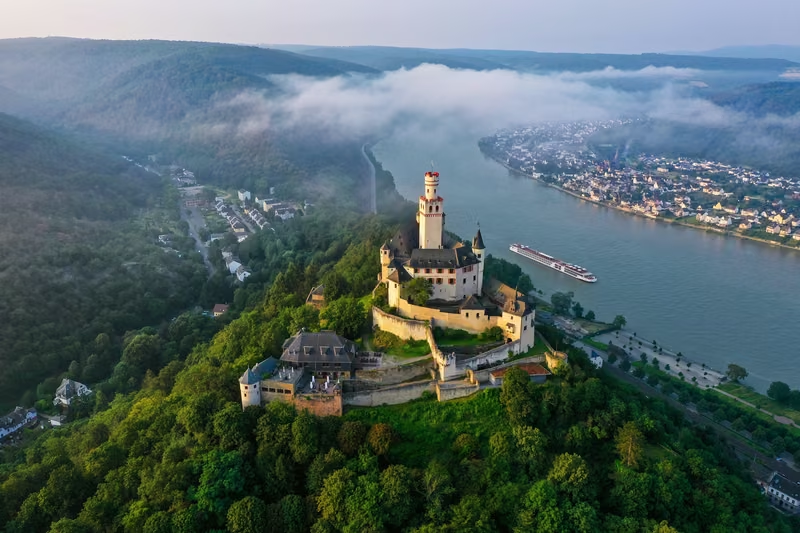
The castles of the Middle Rhine look romantic today, but most were built to make money. In the Middle Ages the river was the main trade route between the Alps and the North Sea, and local lords and archbishops raised fortresses so they could charge tolls on passing boats. Pfalzgrafenstein, the white castle that sits on an island in the river near Kaub, was built for exactly that purpose. Many castles were wrecked in the wars of the 17th century, and quite a few of those you see from the deck were rebuilt in the 19th century by Prussian royals and wealthy industrialists who had fallen for the Romantic idea of the Rhine.
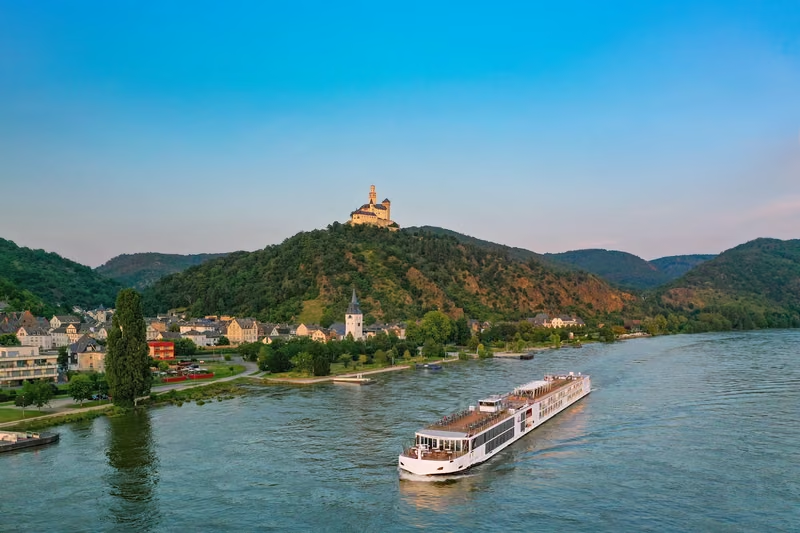
That image owes a great deal to writers and painters. Heinrich Heine's poem about the Lorelei, written in the 1820s, was later set to music and sung all over Germany, and J. M. W. Turner sketched and painted the valley on several visits. Marksburg, above Braubach, is the only hilltop castle on this stretch never to have been destroyed. In 2002 UNESCO listed the valley between Bingen and Koblenz as a cultural landscape, recognising how its castles, villages and terraced vineyards have grown up together over many centuries.
Cologne Cathedral and the Three Kings
Cologne's cathedral exists because of relics. In 1164 the Archbishop of Cologne brought back from Milan bones believed to belong to the Three Kings, and pilgrims soon came in great numbers to see them. A suitably grand church was begun in 1248, inspired by the new Gothic cathedrals of France. Building slowed in the 15th century and then stopped altogether, and for centuries a medieval wooden crane stood on the unfinished south tower, a familiar part of the skyline. Work only started again in 1842, helped by the rediscovery of medieval drawings of the facade, and the cathedral was finally completed in 1880.
When it was finished, its twin spires made it the tallest building in the world for a few years, until the Washington Monument overtook it in 1884. The golden shrine, made by medieval goldsmiths around 1200, still stands behind the high altar. During the Second World War the cathedral was hit many times, yet the structure held while the old town around it was largely flattened. It has been a UNESCO World Heritage Site since 1996. Outside its doors, Cologne keeps its own traditions, from Kölsch beer to the street carnival that takes over the city each year before Lent.
What is included
Viking prices its river cruises to include most of what you need, so there are few extras to budget for once you are on board.
Return flights
Return flights from London and selected regional airports, with ground transfers included when you fly with Viking.
A shore excursion in every port
One included shore excursion in each port of call, usually a guided walking or coach tour, with optional extras to buy.
All meals on board
Breakfast, lunch and dinner every day you are on board, including al fresco dining on the Aquavit Terrace.
Drinks with lunch and dinner
Beer, wine and soft drinks served with lunch and dinner, plus specialty coffee, tea and bottled water at any hour.
Free Wi-Fi
Wi-Fi is included on board at no extra charge, though speeds can vary as the ship moves along the river.
Port taxes and fees
Port taxes and fees are built into the fare, so there are no extra charges waiting at the end.
Onboard gratuities
Gratuities for the crew on board are included in the fare.
Enrichment and performances
Talks on the history and culture of your route, plus local performers who bring the destinations to life on board.
Your stateroom, the ship and its facilities are covered on our Viking Longships page.
Fares
| Cruise | Duration | From, per person |
|---|---|---|
| Rhine Getaway, Basel to Amsterdam | 8 days | £1,695 |
Lead-in fare per person, checked in October 2026. Viking's fares change with the date, direction of sailing and stateroom grade, so please email us for live prices and availability on the departure you have in mind.
Interested in the Rhine Getaway? Email us your preferred month and we will send dates and prices.
Email an enquiry- Best time to go: spring to autumn. April and May bring blossom and quieter towns, while September and October coincide with the grape harvest in Alsace and the Rheingau.
- Basel's old town and riverside are compact and easy to explore on foot, so arriving a day early is a relaxed way to start.
- The pace is gentle, with one main stop or scenic sailing most days. Expect cobbles and a few short slopes in Strasbourg and the old towns.
- This is a natural first river cruise, packing four countries into a week, and it pairs well with a few extra days in Amsterdam.
- Fares start from £1,695 per person, checked in October 2026. Prices change with departure date and stateroom grade.
Rhine Getaway: your questions answered
The fare covers return flights from London and selected UK regional airports, your river view stateroom, all meals on board, beer, wine and soft drinks with lunch and dinner, specialty coffee, tea and bottled water around the clock, Wi-Fi, port taxes, onboard gratuities and one guided shore excursion in every port. Airport transfers are included when you book Viking's flights.
The cruise uses one of Viking's Longships, the slim, Scandinavian-designed vessels built for Europe's rivers. Each carries 190 guests, and every stateroom has a river view. The exact ship depends on your departure date, and we can confirm it when you enquire.
The Rhine season runs from spring through autumn. April and May are fresh and green with fewer visitors, July and August are warmest and busiest, and September and October bring the grape harvest and golden colours on the vineyard slopes of the Middle Rhine. There is no bad month, so it often comes down to your own diary.
Guided tours are mostly on foot through old towns, with some cobbled streets and the occasional slope, such as the lanes of Rüdesheim. You can go at your own pace or stay on board, and the scenic sailing day through the Middle Rhine involves no walking at all. If you have particular mobility needs, ask us before you book.
Return flights are included from London and selected regional airports around the UK. Availability varies by departure, so tell us where you would like to fly from and we will check the options. Booking Viking's flights also means your transfers between the airport and the ship are taken care of.
Yes. Viking offers pre and post-cruise extensions on this itinerary, and many guests choose to spend longer in Amsterdam at the end. Options and prices change, so get in touch and we will tell you what is available for your chosen date.
The cruise runs from Basel in Switzerland to Amsterdam in the Netherlands, calling at Breisach, Strasbourg, Speyer, Rüdesheim, Koblenz, Cologne and Kinderdijk. It also includes a scenic sailing through the Middle Rhine gorge, so you see four countries in eight days.
You might also like
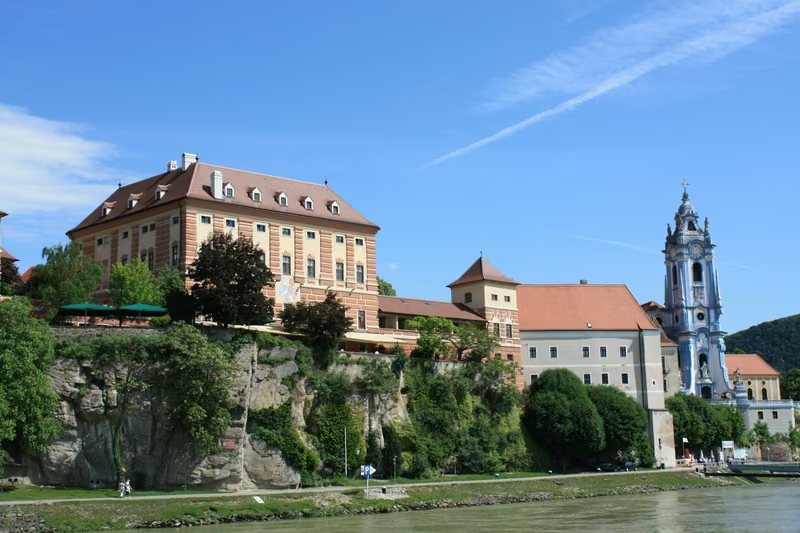
Grand European Tour
Fifteen days across the continent by water, from the bridges of Budapest to the canals of Amsterdam, linking the Danube, the Main and the Rhine.
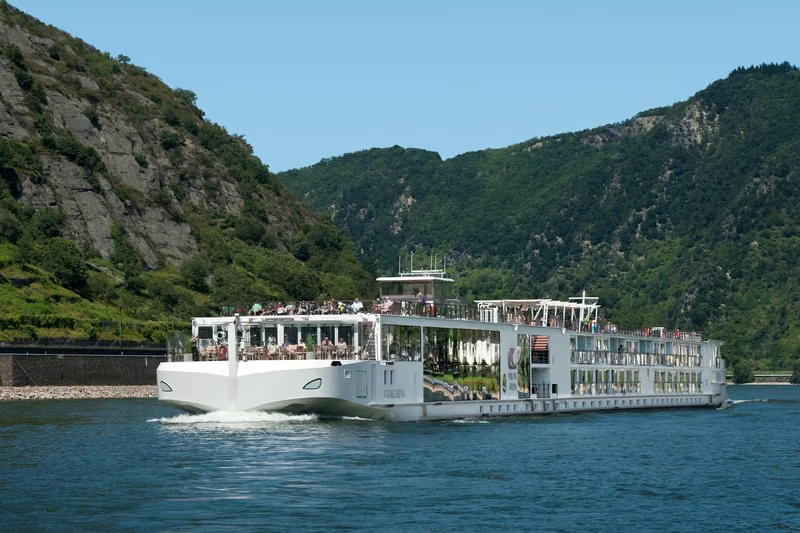
Rhine & Moselle Discovery
Eight days from Roman Trier to Basel, following the winding Moselle to the Rhine and sailing south through the castle country of the Rhine Gorge.
NewCastles, Vineyards & Villages
Eight days from Bavaria to Amsterdam, along the vine-covered Main and through the castle country of the Middle Rhine.